
Hiding AI Is the Losing Position. Apologizing for It Is Also Losing.
Most independent AI music creators have settled into one of two postures. The first is hiding. Upload tracks without disclosure, hope the detection systems miss it, hope nobody asks. The second is apologizing. Disclose reluctantly, with framing that signals embarrassment about the production method, the verbal equivalent of "I used some AI tools, but I really did most of it myself, I promise."
Both postures lose in 2026. The reason both lose is structural, not philosophical.
Hiding lost the moment detection became systematic. Spotify's DDEX AI credit infrastructure went live in April. Deezer has been running its own AI detection system against its catalog and has flagged 13.4 million tracks as AI-generated, all of which are excluded from editorial and algorithmic playlists. SubmitHub rolled out an internal AI detection tool. Watermarking and provenance standards are moving into the AI-content ecosystem, and detection tools are improving across platforms. The probability that a curator, a platform, or a competitor identifies undisclosed AI in your catalog is now meaningfully higher than the probability that you slip through. When the identification happens, it does not arrive as a quiet note. It arrives as a curator decline, a playlist removal, or a flag against your distributor account.
Apologizing loses for a different reason. The reader of an apologetic disclosure infers exactly what the writer is telegraphing: that the work is somehow lesser, that the production process is shameful, that the artist is on probation. That framing follows the work everywhere it goes. Listeners do not respond to apologetic positioning by extending sympathy. They respond by deciding the artist agrees with the people who hate AI music.
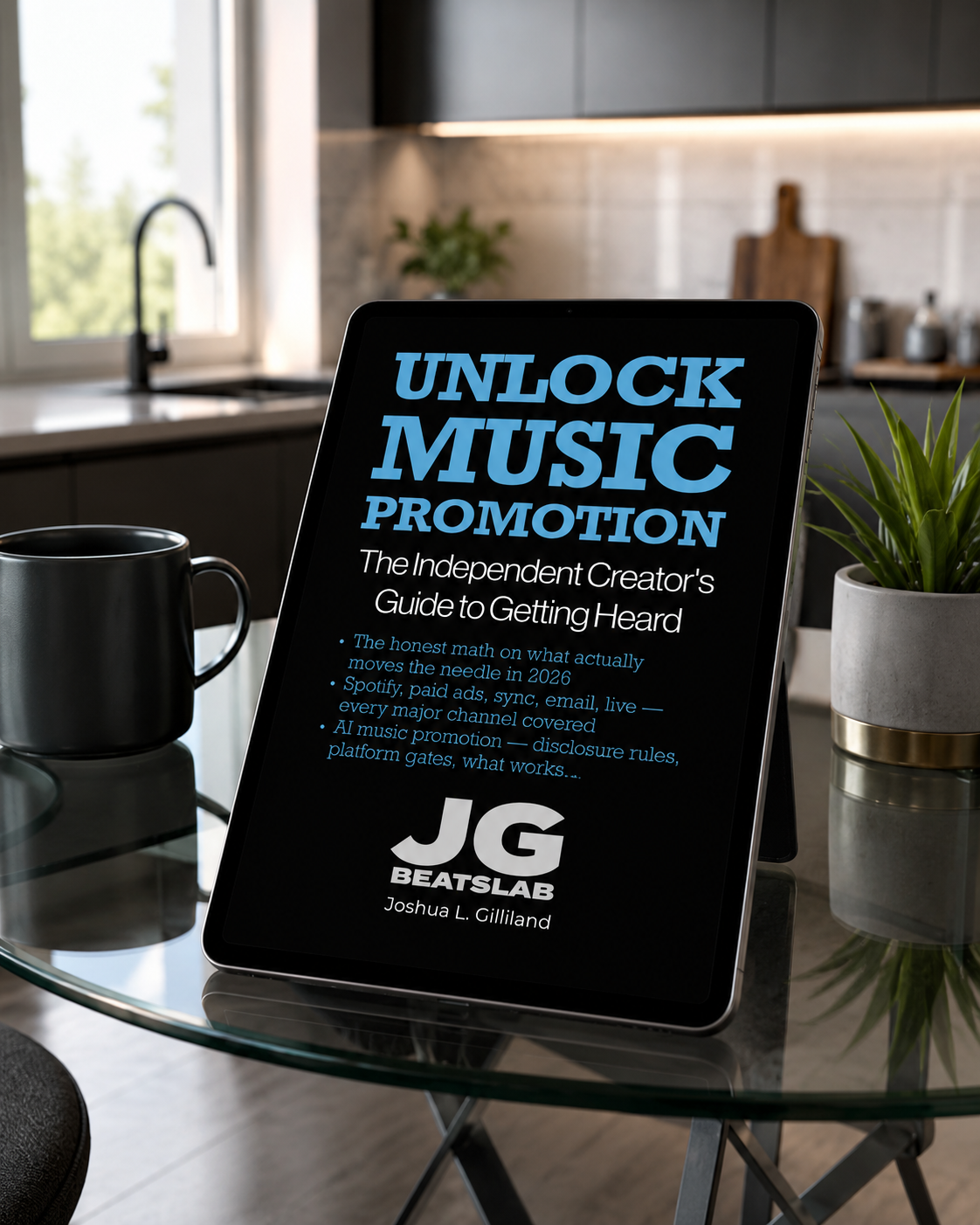
You made the track. Here's how to get it heard.
Most independent creators are great at making music and terrible at getting it heard. Not because they're not trying. Because the music promotion industry runs on advice that's structurally designed to keep you spending without working.
A promotion service that makes money selling playlist placements has no incentive to tell you that playlist placements alone rarely work. A podcast sponsored by an ad network has no incentive to tell you that Meta Ads cost-per-acquisition is often worse than the math suggests. A YouTuber with SubmitHub affiliate links has no incentive to tell you that 60% of SubmitHub submissions get declined.
The independent music promotion industry has become an echo chamber of hope dressed as strategy.
This book is not that.
━━━━━
What's Inside
58,000+ words. 22 chapters across 6 parts. 4 appendices. The complete music promotion landscape for independent creators in 2026, with every claim sourced and every recommendation grounded in actual platform mechanics.
Part I: Foundation. The math of 2026, the AI dimension, and the four diagnostic questions you ask before every campaign.
Part II: Streaming Platforms. Spotify discovery architecture, Spotify's paid stack (Marquee, Showcase, Discovery Mode), Apple Music, YouTube, Amazon, Tidal, Pandora, SoundCloud, and the release cadence mechanics that determine whether the algorithm picks you up.
Part III: Playlists, Paid Promotion, and Fraud. Legitimate playlist services, the playlist scam industry, paid ads across Meta, TikTok, YouTube, and Google.
Part IV: Social and Discovery. TikTok after the USDS deal, Reels and Shorts for the 45–65+ demographic, narrow-purpose platforms (LinkedIn, Threads, Bluesky, X).
Part V: Owned Channels. Email and newsletters — the most undervalued asset. Subscription, patronage, community. Bandcamp, the AI ban, and the direct-to-fan gap.
Part VI: Beyond Streams. Sync licensing. Press, podcasts, and the death of the music blog. Brand partnerships and cross-promotion. Live performance. Distribution and the AI music dimension. The long game.
Plus four appendices: Service Comparison Reference, Glossary, Promotion Math Quick Reference, and Resource Directory.
━━━━━
What You'll Master
How Spotify's algorithmic discovery actually works and what signals drive Discover Weekly and Release Radar placement. The Spotify Paid Stack — Marquee, Showcase, Discovery Mode — and when each is worth the spend. Release cadence mechanics: pre-save windows, day-one signals, and the 14-day algorithmic window. Legitimate playlist services versus the scam industry, and how to tell which is which. Paid ad math across Meta, TikTok, YouTube, and Google — what works, what doesn't, what the real CPA looks like in 2026. TikTok and Reels strategy for the 45-65+ creator specifically. The owned-channel layer: email, newsletter, subscription, community. Sync licensing — the highest-margin channel an independent can access. Distribution and AI disclosure mechanics in 2026.
━━━━━
⭐⭐⭐⭐⭐ "Makes me feel more like a producer rather than a helpless user. I now have a workflow and a methodology for maximizing what I get out of Suno." — Verified Purchase
━━━━━
Want the Full System: The Red Lab Library
Unlock Music Promotion is one book. The Red Lab Library is the entire system, in one place, for one price.
✓ All seven books: Unlock AI Music, Unlock Suno: The Complete Guide, Unlock Music Rights and Registration, Unlock Music Promotion, Unlock Mureka, Unlock Reaper, and The AI Music Revolution
✓ Red Lab Protocol research reports: blind-tested platform comparisons
✓ Red Lab Case Studies: end-to-end production breakdowns of real tracks
✓ Genre Blueprints: tested prompt frameworks ready to use, the majority Red Lab Exclusive
✓ The Field Notes and the Quick Start Kit
✓ The 3-Song Sprint course
✓ Fader, your AI Studio Manager
Hundreds of creators across dozens of countries. $97, one time. No subscription.
jgbeatslab.com/store/p/red-lab-library
━━━━━
Format
Instant digital download — PDF and ePub. Compatible with all major e-readers and PDF viewers.
━━━━━
After Purchase
You'll see a download button on screen immediately. A download link will also be emailed to you — check your spam folder if you don't see it. Need help? Visit jgbeatslab.com/order-help
The winning posture is the third option, and it is the one almost nobody is taking.
The Disclosure Discipline
The Disclosure Discipline is what the Lane 2 creator does instead. It has four operational components.
In the distributor metadata, disclose accurately at upload. DistroKid supports DDEX-aligned AI credit fields. Use them. The field should name the AI tools involved, identify the human creative roles, and describe the workflow in matter-of-fact language: "Vocals generated using Suno. Lyrics written by [name]. Arrangement, mixing, and mastering by [name]." This documentation is for platforms and supervisors, not for listeners. It travels invisibly behind your release and creates the compliance record that protects you when policy enforcement tightens. Disclosed compliance ages better than undisclosed avoidance.
In SubmitHub pitches and curator outreach, lead with the workflow plainly. The personalized message field is the right place: "This track was created using AI tools for vocal synthesis, with human production, mixing, and final curation. I think it fits the [mood] vibe of your playlist." A curator who is categorically anti-AI declines the pitch. That is a small loss, because the same curator would have declined and damaged the relationship if they discovered the AI involvement after acceptance. A curator who is AI-neutral or AI-positive reads the pitch, evaluates the work on its merits, and respects the transparency. The net trade is favorable, every time.
In the artist bio across platforms, describe the production method in the same register you would describe any other creative process. "AI-assisted production with human arrangement and final mixing." Not a confession. Not a defense. A description. The listener who cares about the work reads it and understands the workflow. The listener who is hostile to AI has already decided based on the sound, not the bio.
In sync submissions and licensing pitches, disclosure becomes non-negotiable. Most major sync libraries will not accept undisclosed AI involvement, and the liability for the supervisor is too high. Include a one-line production note in the submission: "AI-assisted with human arrangement and mixing." Have your DAW project file ready as proof of human authorship if challenged. Sync supervisors who are AI-friendly will work with you. Sync supervisors who are AI-hostile will pass. The middle category, supervisors who are AI-cautious, will accept transparency and reject deception. That is the segment that grows the most when you disclose.
Why the Disclosure Discipline Is a Positioning Advantage
The 45 to 65+ audience the Unlock System is built for has spent decades inside creative fields. They know tools have always been part of the work. A guitarist with an effects pedal is using a tool. A mastering engineer with a compressor plugin is using a tool. A photographer with Photoshop is using a tool. The objection to AI is rarely about tools as a category. It is about deception, displacement, and craft erosion.
A Lane 2 creator who discloses cleanly is operating against all three of those concerns. The deception complaint does not apply. The craft erosion complaint loses force when the human creative direction is visible. The displacement complaint shifts from "AI is replacing musicians" to "this musician is using AI deliberately and openly," which is a different conversation entirely. Disclosure done well moves the creator from defendant to operator. The frame changes.
The listener who reads "AI-assisted with human arrangement and mixing" and then hears work that holds up will reach the conclusion the work earns. The listener who is hostile to AI was never the customer. The listener in the middle, the one who does not care about the production method as long as the music works, gets the music and ignores the metadata. Three audiences, one disclosure, no contradiction.
That is the positioning advantage. Disclosure is not a tax on Lane 2 work. It is the move that makes Lane 2 work credible at scale.
The full Disclosure Discipline framework, including the platform-by-platform enforcement landscape, the EU AI Act timeline, the sync supervisor segmentation, and the distributor comparison for AI-assisted creators, lives in Chapter 3 of Unlock Music Promotion. The book is $9.99 individually. The Minimum Starter Kit at $27 combines it with Unlock Suno and Unlock Music Rights and Registration, which is the full production-promotion-rights triangle for a disclosed Lane 2 release.
