
The Music Industry Makes $105 Billion a Year. Here's What AI Actually Threatens.
There's a number that never shows up in the AI music debate.
$105 billion.
That's what the global music industry generated in 2023, according to Goldman Sachs. Not streaming revenue. Not recorded music. The whole thing — live events, sync licensing, merchandise, publishing, recorded music, performance rights, the entire ecosystem that exists around the act of making and distributing music.
$105 billion.
And the conversation about AI music is almost entirely focused on one slice of one segment of that number. Let me show you what I mean.
The Actual Pie
Of that $105 billion, roughly $65 billion flows to music makers in some form — artists, songwriters, producers, and rights holders. The rest goes to venues, retailers, promoters, and the infrastructure that surrounds the business of music.
Of that $65 billion, streaming accounts for approximately $20.4 billion. That's the segment everyone is fighting about, and it's the revenue pool that AI music is theoretically threatening.
So before we go further... we're already talking about $20.4 billion out of $105 billion. That's roughly 19% of the total industry. Now let's talk about what AI music actually represents inside that $20.4 billion.
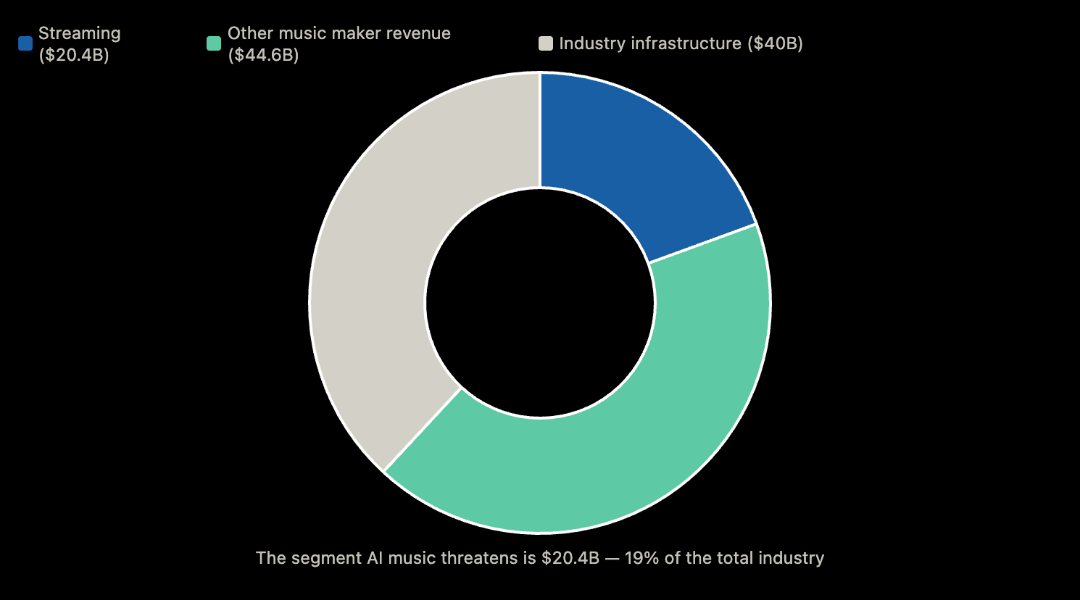
The $105 Billion Pie
The Upload Share vs. The Listen Share
Deezer reported that AI-generated music accounts for approximately 18% of all uploads to their platform. That number gets cited constantly as evidence that AI is taking over music.
Here's what that number doesn't tell you: uploads aren't streams.
Actual AI music listening share on major platforms sits around 1.5% of total streams. Eighteen percent of uploads. One and a half percent of listens. The gap between those two numbers is the gap between a flood of content and an audience that has actually chosen to engage with it.
Those are very different things.
What 1.5% Actually Means in Dollars
Spotify paid out more than $11 billion to the music industry in 2025 — the largest annual payment to music creators from any retailer in history. Apply the 1.5% AI listening share to the global streaming revenue pool of approximately $20.4 billion, and you get roughly $306 million currently flowing to AI-generated music across all platforms.
That's the actual size of the competitive threat in dollar terms today. Not a headline number. Not a projection. What AI music is actually earning right now.
$306 million. In a $105 billion industry.
What the Median Artist Is Actually Losing
This is where the conversation needs to get honest — and specific.
The average streaming payout gets distorted by the top tier. Taylor Swift's numbers pull the average up in ways that have nothing to do with what a working independent artist actually sees. So let's use the median.
The median independent artist earns somewhere between $1,000 and $5,000 per year from streaming. Let's use $3,000 as a working estimate.
Assuming AI streams displace human streams relatively evenly across the board, the portion of that $3,000 theoretically displaced by AI competition is approximately $45 per year.
Forty-five dollars.
Even at the CISAC 2028 projection — where AI music grows to 20% of streaming — that displacement grows to roughly $600 per year for the median artist.
That's a real number and it deserves to be taken seriously. But it also needs to be held next to the full picture. The median independent artist isn't losing their livelihood to AI music streams. They're facing $45 of annual competitive pressure today... in a revenue stream that was already paying them $3,000 on a good year.
The existential threat framing doesn't match the math.
The Honest Projection
CISAC projects that by 2028, AI-generated music could account for 20% of streaming revenue if current trends continue. That's the projection that gets the most attention and generates the most alarm.
Let's take it seriously and do the math.
Twenty percent of $20.4 billion is approximately $4 billion. That's the projected AI music streaming revenue in 2028 — in a scenario where the trend accelerates significantly from where it sits today.
Four billion dollars. In a $105 billion industry.
That isn't a trivial amount. That's real money and real displacement for the creators who lose that revenue, and I'm not dismissing it. But it's also not the extinction-level event that the loudest voices in this debate are describing.
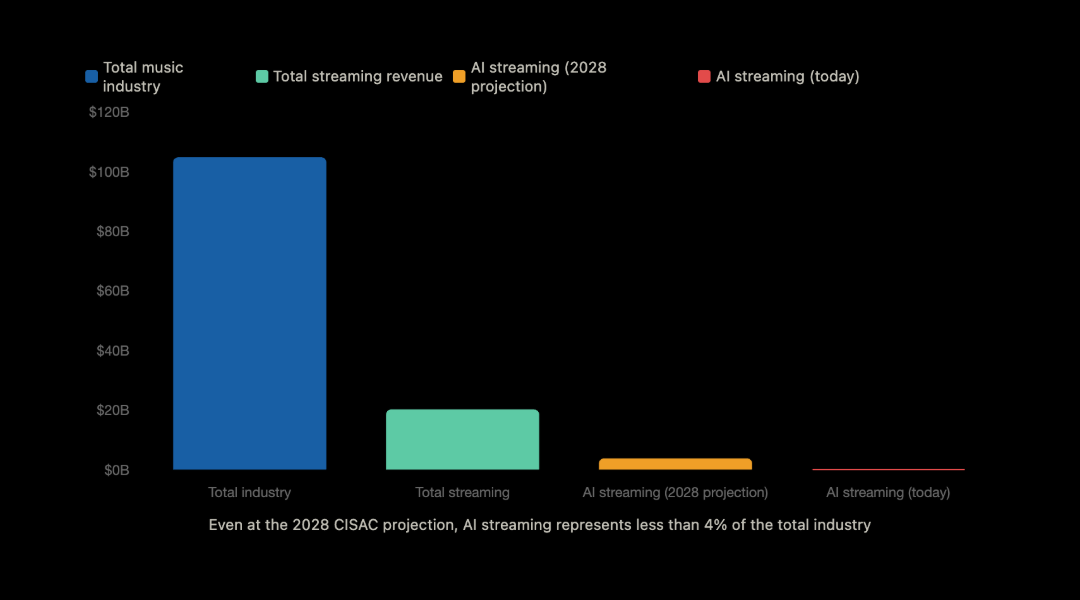
AI Streaming <4% of Total Industry
What This Actually Means
The music industry isn't being destroyed by AI. A specific revenue segment — streaming royalties for recorded music — is facing real competitive pressure from AI-generated content. That's a meaningful problem for the creators who depend on that revenue stream, and it deserves serious attention and serious solutions.
But $101 billion of the industry doesn't care whether your track was made with a guitar or a generative model. Live music doesn't care. Sync licensing doesn't care — it cares whether the track fits the brief. Publishing revenue doesn't care. Merchandise doesn't care.
The entire argument against AI music is concentrated in the smallest, most commoditized, lowest-margin segment of the industry — the per-stream royalty on a platform that pays fractions of a cent per play.
If your entire business model depends on streaming royalties from recorded music, AI is a real threat and you should take it seriously. If your business model includes any of the other $85 billion that makes up this industry... the conversation looks very different.
The Director's Perspective
Here's what I keep coming back to.
The creators who are going to win the next decade aren't the ones who successfully lobbied to slow down AI adoption. They're the ones who understood the landscape clearly, made strategic decisions about where to compete, and built catalogs and revenue streams that aren't entirely dependent on per-stream payouts from Spotify.
Sync licensing. Direct-to-fan sales. Live performance. Publishing. These aren't niche revenue streams. They're the majority of a $105 billion industry.
The AI music debate has been framed as an existential threat to music. The data says it's a competitive pressure on one slice of one segment of a very large, very resilient industry.
Know the actual numbers. Make your decisions from there.
If you're building a catalog and a revenue strategy that goes beyond streaming royalties, Red Lab Access is where that system lives.
