
The Difference Between Generating and Directing
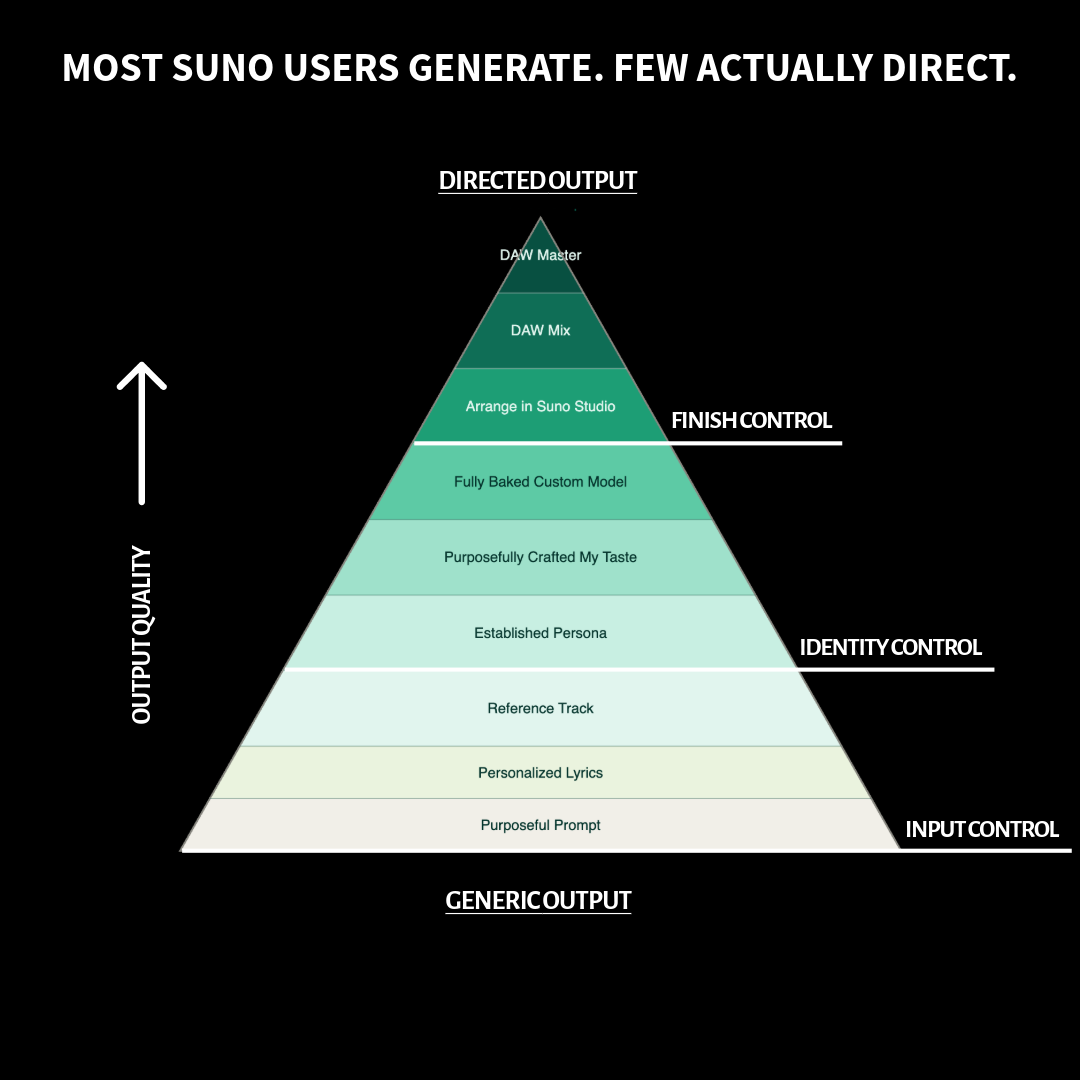
There is a pyramid in AI music production. Most creators are at the bottom of it. A few are climbing. Almost nobody is at the top.
The bottom is not a bad place. It is where everyone starts. You open Suno, type a prompt, hit generate, and something comes out. Sometimes it's surprisingly good. Sometimes it isn't. Either way, you generated a song.
But you didn't direct one.
That distinction matters more than most people realize. And it's the difference between a catalog that sounds like everyone else's and one that sounds like yours.
The Baseline: Generic Output
When you give Suno a vague prompt, it defaults to the average. The model has been trained on an enormous range of music, and without specific direction, it makes statistically safe choices. Safe tempo. Safe instrumentation. Safe structure. Safe everything.
The result is competent. It is also indistinguishable.
This is the vending machine problem. You put something in. You get something out. The machine decides what that something is. You're not directing the output — you're hoping for it.
Most AI music lives here. Not because the creators lack talent. Because they haven't yet built the system that moves them up the pyramid.
Tier 1: Input Control
The first tier is where you start taking control of what goes into the generation. Three steps make up this layer.
Purposeful prompt. This isn't about writing more words. It's about writing the right words. Sub-genre instead of genre. Mood as a harmonic instruction, not a feeling. Texture as a production detail, not an aesthetic. A purposeful prompt gives the model architecture to work within instead of open water to drift in.
Personalized lyrics. This is where your creative voice enters the equation. Your story. Your language. Your emotional specificity. AI can generate lyrics — and they will be grammatically correct and emotionally generic. Your lyrics carry weight the model cannot manufacture. They are the human fingerprint on the track.
Reference track. Once your lyrics are locked, a reference track gives the model a sonic target. Not something to copy — something to aim at. A reference anchors the generation to a specific emotional register, production style, and energy level. It tells the model what world this song lives in.
These three steps alone move you significantly up the pyramid. Most creators never take all three consistently. The ones who do notice the difference immediately.
Tier 2: Identity Control
The second tier is where your artistic identity gets built into the system itself — not just into individual prompts.
Established persona. A persona is a documented artist identity that travels with every generation. Genre. Vocal character. Thematic territory. Influence map. When you build a real persona and apply it consistently, the AI starts generating within a defined creative space instead of the entire possibility space. Your outputs begin to sound like they belong to the same artist.
Purposefully crafted My Taste. Suno's My Taste feature builds a profile of your aesthetic preferences over time. Left unmanaged, it blends everything you've ever generated — country bleeds into techno, your experimental work pollutes your commercial output. Managed intentionally, it becomes a powerful calibration tool. The platform learns what you actually want, not just what you've clicked.
Fully baked custom model. This is the deepest identity control available. You upload your catalog directly in Suno and train a version of its engine on your sound. When it works — and it requires a curated, consistent catalog to work well — generations come out textured with your sound. Not copying it. Inhabiting it.
Creators who reach this tier aren't working with AI anymore. They've built an AI that works for them.
Tier 3: Finish Control
The top tier is where the human takes full authorship of the final product. This is where most people think the work is done — when it's actually just beginning.
Arrange in Suno Studio. Before a track ever leaves Suno, there are decisions to be made. Section structure. Energy arc. Transition points. Suno Studio gives you the tools to shape the arrangement with intention rather than accepting whatever the generation produced. This step alone is the difference between a raw generation and a finished song.
DAW mix. Pulling stems into a DAW introduces human judgment at the element level. You're not just mastering the stereo file — you're making decisions about individual components. Balancing. Shaping. Removing what doesn't serve the song. Adding what does.
DAW master. The final step is the professional finish. Loudness targeting. True peak limiting. Artifact cleanup. Streaming compliance. A properly mastered track sounds like a record. An unmastered AI export sounds like a demo — even a brilliant one.
Every track that goes through all three Finish Control steps carries a level of intentionality that the output alone cannot communicate. It sounds finished because it is.
What the Pyramid Actually Means
The pyramid is not a checklist. You don't need to hit every step on every track. Some tracks need all nine. Some need three. The point isn't compliance — it's awareness.
Every step you take up the pyramid is a decision only a Director makes. A vending machine operator stops at the base. They generate. They download. They post. The output reflects the machine's choices, not theirs.
A Director uses the machine as a starting point and takes it somewhere the machine couldn't go alone. The output reflects their creative vision — executed with AI, owned by a human.
That's Lane 2. Human-authored, AI-assisted. Your story. Your system. Your sound.
The pyramid exists whether you engage with it or not. The question is where on it you're choosing to operate.
The System That Builds Directors
Every level of this pyramid is covered inside Red Lab Access. The prompt architecture. The persona methodology. The My Taste and Custom Model workflows. The Suno Studio arrangement process. The full Reaper mastering chain. The research that tells you which tools perform best at which jobs.
It's not a collection of tips. It's a system — built specifically for creators who are done generating and ready to direct.
Red Lab Access — one price, lifetime access, everything included.
