
How to Actually Integrate AI Into Your Music Workflow (Without Producing Slop)
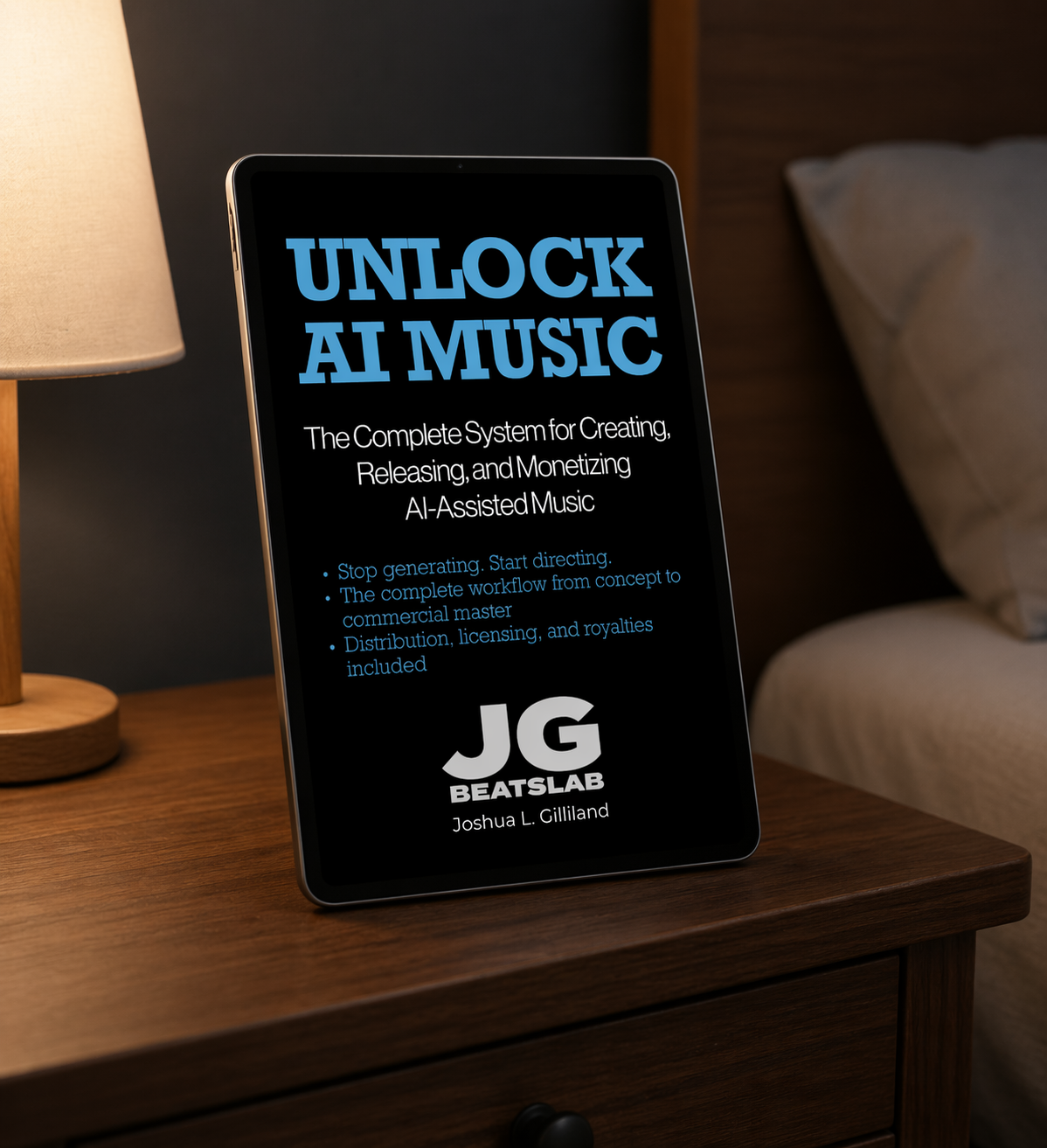
Start here. The complete foundation for a serious AI music catalog.
Most AI music education stops at "generate." Some goes as far as "mix and master." Almost none of it walks you through the complete system — from building your artistic identity through commercial release, royalty collection, catalog management, and long-term revenue strategy.
This is the book where you decide whether you are serious. Every other book in the Unlock series assumes you already know what you are doing. This is the one where you make that decision.
━━━━━
Where This Book Fits
Unlock AI Music is the entry point to the entire JG BeatsLab system. It is where you build the foundation — the mindset, the workflow, the business framework — before you go deep on any specific platform or tool.
Once you have the foundation, the rest of the Unlock series builds on it. Unlock Suno for platform mastery. Unlock Mureka for a second generation engine. Unlock Reaper for professional mastering inside a DAW. Unlock Music Rights & Registration for getting paid correctly on every release.
Or skip the individual books entirely and get everything at once inside Red Lab Library.
But it starts here.
━━━━━
What's Inside
205 pages. 12 chapters. 6 appendices. The complete end-to-end workflow for serious AI music creators.
The Director's Mindset — how to think about AI music before you generate a single note
The Infinite Studio Setup — your complete tool stack, from AI platforms through DAW integration
The Human Moat — what makes your music defensible, distinctive, and yours
Language as Instrument — advanced prompting strategy built on how these models actually work
The Director's Cut Workflow — from Golden Seed through finished commercial master
Quality Control and Taste Development — the systems that make every track better than the last
The Revenue Map — four royalty tiers, multiple income streams, all mapped
Platform Mastery — distribution, licensing, and Content ID across all major platforms
The 90-Day War Plan — a concrete catalog-building roadmap
Catalog Management at Scale — how to manage a growing body of work
Automation and Batch Production — how to scale output without sacrificing standards
Advanced Strategies — the long game for building a mature Lane 2 music business
Six appendices include a complete prompt library, platform setup checklists, a copyright registration guide, a revenue tracking template, an entrepreneur's toolkit, and a full troubleshooting handbook.
━━━━━
Want the Full System: The Red Lab Library
Unlock AI Music is one book. The Red Lab Library is the entire system, in one place, for one price.
✓ All seven books: Unlock AI Music, Unlock Suno: The Complete Guide, Unlock Music Rights and Registration, Unlock Music Promotion, Unlock Mureka, Unlock Reaper, and The AI Music Revolution
✓ Red Lab Protocol research reports: blind-tested platform comparisons
✓ Red Lab Case Studies: end-to-end production breakdowns of real tracks
✓ Genre Blueprints: tested prompt frameworks ready to use, the majority Red Lab Exclusive
✓ The Field Notes and the Quick Start Kit
✓ The 3-Song Sprint course
✓ Fader, your AI Studio Manager
Hundreds of creators across dozens of countries. $97, one time. No subscription.
jgbeatslab.com/store/p/red-lab-library
━━━━━
Format
Instant digital download — PDF + ePub. Compatible with all major e-readers and PDF viewers. No blurry screenshots. 100% actionable operational data.
━━━━━
After Purchase
You'll see a download button on screen immediately. A download link will also be emailed to you — check your spam folder if you don't see it. Need help? Visit jgbeatslab.com/order-help
Most creators I talk to are using AI wrong.
Not in the moral sense. In the architectural sense.
They have ChatGPT open in a browser tab. When they hit a problem in Suno, they alt-tab over, type a vague question, paste in a vague answer, and get back to work. The output reflects the input. Generic question, generic answer, generic result. Then they do it again the next day with the next problem.
This is not AI integration. This is AI tab-switching. And it's why so much AI-assisted music sounds like AI-assisted music.
A recent Harvard and OpenAI study suggested that most ChatGPT usage still clusters around basic guidance, information seeking, and writing tasks. After three years of generative AI being widely available, most users haven't moved beyond what amounts to a smarter Google search. The deep work (the synthesis, the methodology, the application of taste and judgment) is rarer than it should be.
That gap is the entire opportunity for serious creators. And closing it is not about working harder with AI. It's about integrating AI differently.
The Architecture That Actually Works
Effective AI integration in a creative workflow has four characteristics. Once you see them, you can't unsee how broken most setups are.
Specialized over generic. A general-purpose chatbot is great for general-purpose questions. It is not great for the specific decisions you make as an AI music producer. Tempo drift in a Suno generation. The right LUFS target for a Spotify upload. Whether your prompt syntax is going to produce vocals or kill them. These are domain questions. They need domain expertise.
Trained on a methodology, not just topic knowledge. There's a difference between an AI that knows about AI music and an AI that knows how you approach AI music. The first one tells you what's possible. The second one tells you what to do given the framework you're already working in. The framework matters. Without it, every answer is a fresh start.
Embedded in your workflow, not switched to. Every time you alt-tab away from your DAW or your generation tool, you break your concentration and you lose context. The AI should be where you work, not somewhere else.
Available when the problem appears. Creative work doesn't keep business hours. The question that lands at 11 PM is the same question that lands at 11 AM. If your AI tool has hours of operation, it's not really part of your workflow.
That's the architecture. The question is what it looks like in practice.
Fader as the Worked Example
When I built JG BeatsLab, I needed a tool that did all of this. Not in theory. In practice. So I built it.
Fader is an AI Studio Manager trained on the JG BeatsLab methodology. It lives inside ChatGPT, available to anyone who buys a book or joins Red Lab Access. It does four things that a general-purpose ChatGPT session can't do well:
Prompt audits. You paste in a Suno prompt. Fader checks the syntax, flags the elements that are likely to produce inconsistent results, and gives you a corrected version with the reasoning. Not "here are some prompt tips." A specific audit of the specific prompt you're about to use, against the specific methodology you're working in.
Technical fixes. Tempo drift, spectral combing, mix imbalance, LUFS calibration. These are recurring problems in AI music production. Fader knows what they sound like, what causes them, and how to fix them. You describe the problem. It tells you the fix.
Mastering specs. Streaming platforms have specific technical requirements. Spotify, Apple Music, YouTube, TikTok all have their own targets. Fader gives you the exact specs for the platform you're delivering to, no Google search required.
Compliance and copyright posture. Fader is built around Lane 2 production: human-authored, AI-assisted work where the creator writes, directs, edits, selects, and finishes. That matters for quality, but it also matters for copyright. Under current law, purely AI-generated work has no copyright protection. Lane 2 production preserves the human authorship that makes your work yours. Fader knows the current rules, the platform terms of service, and the difference between work that's defensible and work that isn't.
None of these are revolutionary capabilities in isolation. What makes Fader work is the integration. It's specialized for AI music, trained on a specific methodology, available inside the same tool you're already using for general questions, and available 24/7. That's the architecture.
The Principles, Generalized
You don't have to use Fader. The point of this piece is bigger than that.
If you're a serious creator integrating AI into your workflow, you should be thinking about your AI setup architecturally. Not "what's the best chatbot." That's the wrong question. The right questions are:
What's the methodology I'm operating inside? Most people skip this. They just use whatever AI is in front of them and hope the output makes sense. It rarely does. If you don't have a methodology, the AI doesn't either, and the output will reflect that.
What specialized tools could I build or use that are trained on that methodology? Custom GPTs, Claude Projects, narrowly scoped agents, even prompt libraries you've refined over time. Specialized expertise beats generic knowledge every time. If you have a methodology, train your tool on it.
Where does the AI need to live in my workflow? If it lives in a tab you switch to, you'll use it less and worse. If it lives where you work, you'll use it more and better. The friction matters.
How available is it? If you can only access it during your morning planning session, you'll lose the value of being able to ask the question when it actually appears.
These principles apply whether you're using Fader, building your own custom GPT, working with another AI tool, or some combination. The point is that AI integration is an architectural decision, not a tool selection.
The Bigger Argument
The reason most AI-assisted music sounds like AI-assisted music is that most creators are using AI as a generic answer machine. The output reflects the input. Generic in, generic out.
The creators producing work that doesn't sound like AI slop aren't producing it that way because they're using better AI. They're producing it that way because they have a methodology, they've integrated AI into that methodology specifically, and they're applying taste and judgment to the output.
That's the difference between a vending machine operator and a director. The vending machine operator presses a button and accepts what comes out. The director makes decisions about what they want, applies a system to get it, and refines until it matches their intent.
AI integration done right is what the director's tools look like.
The future of AI in creative work is not generic content firehoses. It's specialized expertise embedded in workflows, trained on methodologies, available where and when the work happens. That's not a prediction. It's already happening for the creators who are building real catalogs.
If you're integrating AI into your music workflow, build it the right way. Or use the tools that have already been built that way.
Stop tab-switching. Start directing.
Fader is included with every book at jgbeatslab.com and with Red Lab Access. The methodology it's trained on is documented in Unlock AI Music, the foundation book that walks through the Director's Cut framework, the architecture of effective AI music production, and how to apply it to your own catalog.
