The People Cheering Spotify's Verification System Aren't Going to Be Verified Either
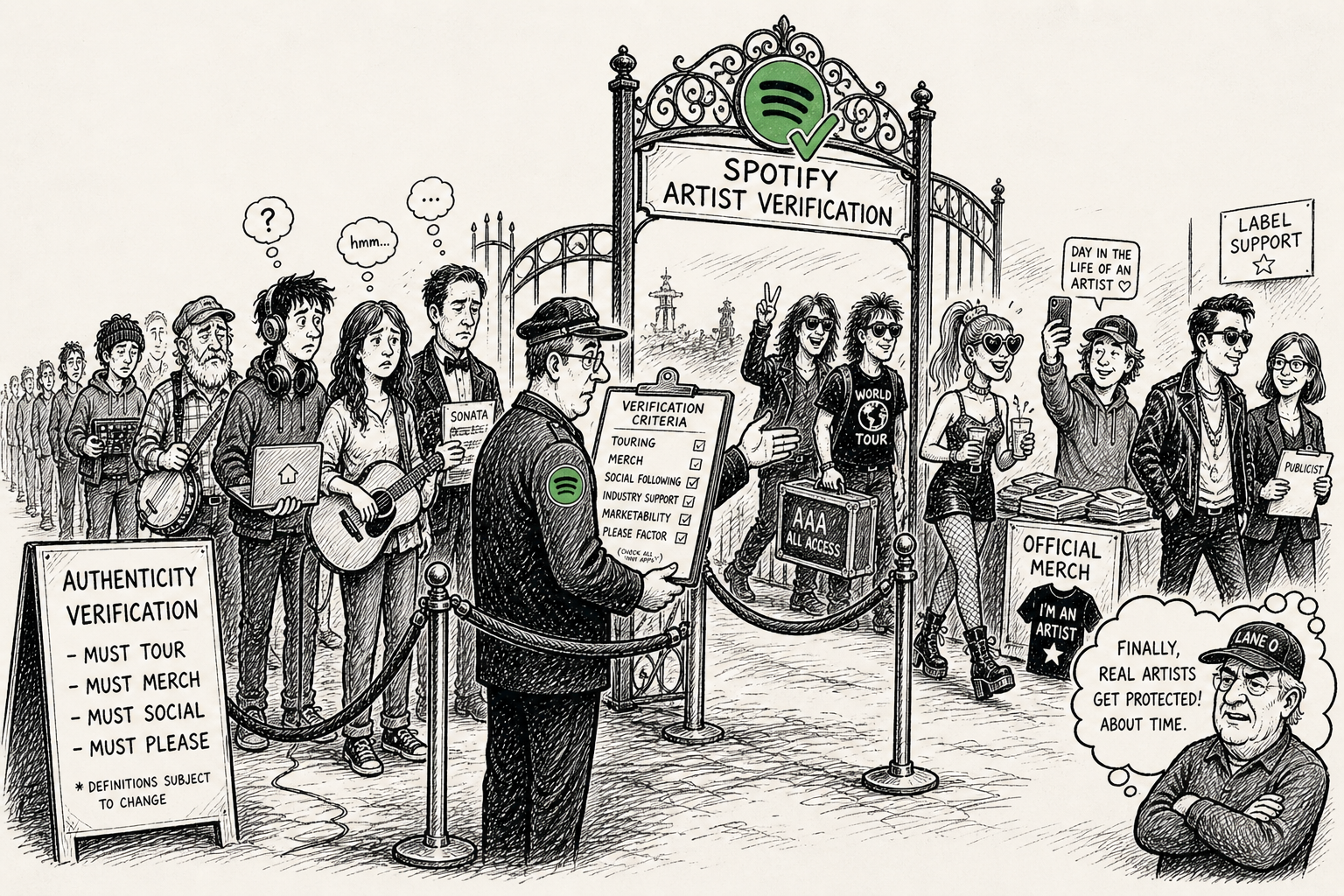
Spotify rolled out artist verification yesterday. Green checkmark on the artist profile. Trust badge. The framing in the announcement: helping listeners distinguish authentic human artists from AI-generated music in an era where that distinction matters.
Do I care that Spotify is doing this? Not really. Spotify is a private company. They can build whatever verification system they want. A couple hundred monthly listeners on my fully human music project Gillsaw doesn't translate to meaningful streaming revenue regardless of whether I'm verified.
What I do care about is the pattern this fits into. The big money inside the music industry continues to build guardrails and moats designed to protect their own. The verification system is the latest example.
What the Criteria Actually Filter For
Spotify's stated criteria for verification include:
Consistent listener activity and engagement over time, good standing with platform policies, identifiable artist presence both on and off platform including concert dates, merch, and linked social accounts.
What gets verified isn't "is this music made by a human." What gets verified is "does this artist look like a commercial artist by 2010s standards." Touring footprint. Active social media. Visible merch operation. The kind of presence that costs money and time to build.
The criteria are also subjective. "Consistent listener activity" has no defined threshold. "Identifiable artist presence" has no minimum. Spotify's editorial team gets to decide which artists clear the bar.
This is not authenticity verification. This is curation dressed up as verification.
The Question Worth Asking
What will the verified checkmark actually be used for?
The official answer is "trust signal for listeners." The likely real answer is downstream tiering. Verified-only playlists. Verified-only algorithmic placement. Verified-only revenue share considerations. The badge becomes the gate, and the gate determines who gets distribution.
If that happens, the verified tier will look a lot like the major-label tier with some independent artists big enough to have measurable gravity layered in.
The independent bedroom producer with a real catalog of human-authored music will be in the same non-verified bucket as faceless AI persona accounts.
The traditional human artist who refuses social media will be in the same non-verified bucket as content farms.
The session musician releasing under their own name will be in the same non-verified bucket as bot-uploaded ambient slop.
Same checkmark status. Different reasons. Same downstream consequences.
I don't know if Spotify will build playlist tiering on top of verification. I do know the incentive structure points that direction. I also know that even if they don't, advertisers and brands will treat the checkmark as a signal of who's a "real" artist worth working with. The economic effect will be the same whether Spotify formalizes it or not.
The Part That's Actually Worth Paying Attention To
A meaningful number of the people who push back on AI music in public, who post about how "real musicians have integrity" and "real artists don't use machines," have smaller audiences on Spotify than my Gillsaw project does.
They are also going to be on the wrong side of this verification system. Same line as me. Same uncertainty about whether they meet undefined thresholds. Same vulnerability to whatever downstream tiering shows up next.
But they will celebrate the rollout.
The pattern is consistent across every cultural authenticity panic of the last hundred years. The people demanding the gatekeepers protect them from a perceived threat are rarely the people the gatekeepers actually protect. The gatekeepers protect themselves and the commercial template they've built around. The people doing the cultural work of demanding the gates get built are the unpaid volunteer marketing department for a system that will exclude them too.
This is what is happening right now in the AI music conversation. Independent artists who have spent the last two years insisting that AI music is illegitimate are about to discover that the verification system they're cheering for has criteria that have nothing to do with whether they used AI and everything to do with whether they fit a commercial template most independent artists can't afford to build.
⭐⭐⭐⭐⭐ 4.9/5 | Hundreds of creators across dozens of countries
Most AI music creators are building a quilt.
YouTube tips. Reddit threads. ChatGPT answers that don't connect to anything. Six months of collecting micro-optimizations from sources that have no relationship to each other, applied to a workflow with no common foundation.
The quilt feels free. It is not free. The hidden cost is momentum — every time you hit a problem and don't know where to turn, every time you get contradictory advice and can't evaluate which is right, every time you make progress and can't replicate it because you don't understand why it worked.
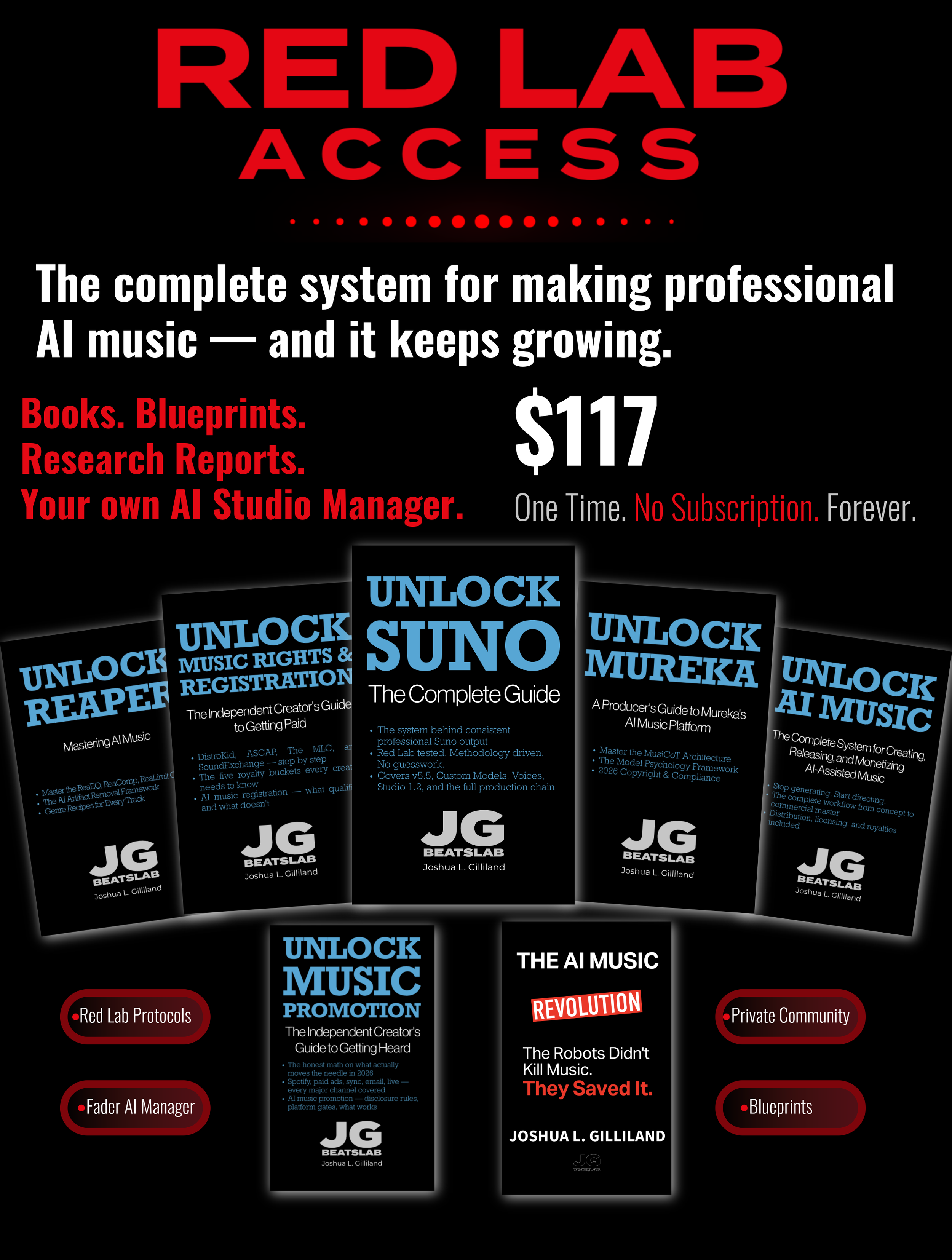
Red Lab Access is the alternative.
Red Lab Access isn't a folder of downloads. It's a complete system — from your first Suno session to releasing and monetizing a real catalog.
Every piece of content inside Red Lab Access was built for the same workflow. Every book connects to every framework. Every research report tests what the books teach. Every Blueprint applies the research. Every case study documents it in action. Fader operationalizes the entire system in real time. The 3-Song Sprint puts it into practice with a finished body of work at the end.
Pull any piece out and it references the same foundation, uses the same vocabulary, builds on what came before it. That is what connective tissue means. That is what the quilt never has.
Members who have been inside for six months don't just know more tips. They think differently about the entire process. They have a common language with other serious creators. They don't have to search through articles and message boards trying to find advice that might apply to their workflow — everything inside Red Lab Access was built for their workflow.
____________
What's Inside
Red Lab Access gives you the full library the moment you join. Choose your own path, or follow the one we built. Here is everything waiting for you.
BOOKS
✓ Unlock Suno: The Complete Guide. The most rigorous, current, actionable professional guide to Suno on the market. Updated for v5.5 and Studio 1.2.
✓ Unlock AI Music. The foundation book of the Unlock series, covering the Director's Cut framework, Lane 2 methodology, studio setup, legal architecture, and the 90-Day War Plan for building a real catalog.
✓ Unlock Reaper: Mastering AI Music. Build a professional Reaper chain using native plugins, hit streaming LUFS targets, turn raw AI exports into finished masters.
✓ Unlock Mureka. The complete Mureka workflow.
✓ Unlock Music Rights and Registration. The full royalty collection workflow across DistroKid, the PROs, The MLC, and SoundExchange.
✓ Unlock Music Promotion. The independent creator's guide to getting heard. Spotify discovery, paid ads, social, sync, email — every major channel and the AI-specific dimensions of all of it.
✓ The AI Music Revolution. The Lane 2 philosophy and where all of this is going.
RESEARCH & CASE STUDIES
✓ Red Lab Protocol™ Reports. Blind-tested platform comparisons. Red Lab Exclusive.
✓ Red Lab Case Studies. End-to-end production breakdowns of real tracks from concept to commercial master. Red Lab Exclusive.
BLUEPRINTS & COURSES
✓ Every Blueprint we've published. Tested prompt frameworks ready to use, with the majority Red Lab Exclusive.
✓ The 3-Song Sprint. Five guided sessions, worksheets and cheat sheets, nearly 2 hours of content.
WORKBOOKS
✓ Fillable application workbooks anchored to the Unlock books. Turn the methodology into committed campaigns, dated plans, and operating documents you can run from.
TOOLS & COMMUNITY
✓ Fader. Your AI Studio Manager, trained on JG BeatsLab methodology. Rated 4.8/5, 40+ ratings, 1,000+ conversations.
✓ Red Lab Quick Start Kit. Five printable reference cards.
✓ Private members-only community.
WHAT'S NEXT
✓ New books, Blueprints, workbooks, research reports, and case studies dropped on a regular cadence.
✓ All future content included automatically — no additional charges, ever
____________
The R&D You Don't Have to Pay For
Every Red Lab Protocol report and every Red Lab Case Study costs real money to produce. A single Case Study documents focused production work, dozens of generations, complete Suno Studio surgery, a full Reaper mastering chain, and the kind of hands-on problem-solving you only learn by doing. Each Red Lab Protocol report requires controlled testing across multiple Suno model versions and dozens of comparison generations. That's hundreds of dollars in tool subscriptions and research time per report, so you don't have to spend it yourself testing tools that might damage your audio or waste your budget.
When a new platform launches, we test it. When Suno updates, we document what changed. When a technique stops working, we flag it. The system stays current so you don't have to.
This isn't a subscription to tips. It's a research lab you buy into once.
____________
What Red Lab Members Are Saying
⭐⭐⭐⭐⭐ "I took my work from awesome to outstanding. Songs I had written to elicit certain emotions now do so every time someone hears them. When someone hears a song and tears start because they have connected with it — that's what writing songs is all about. And the fact that you never have to purchase any future releases is unheard of anywhere." — Irene B.
⭐⭐⭐⭐⭐ "Suno left me with more questions than answers. It was very difficult to find a true expert. The information provided by JG BeatsLab has been outstanding. Responsive, authoritative, and currently the best resource I am aware of. A great value for the money." — Paul J.
⭐⭐⭐⭐⭐ "I had very little control. Now I have a workflow and a methodology. It has completely changed my view on Suno. It's become an integral tool of my songwriting." — Scott H.
⭐⭐⭐⭐⭐ "I've been recording music for 60 years. And every week, I realize how much less I know. This has cleared much of the AI fog, and kept me in the game." — Stephen A.
⭐⭐⭐⭐⭐ "I haven't had time to dig into the Suno stuff yet. I got so excited about the mixing assistant. That is the best thing I have had as a tool for my own productions, period. All confusion gone. Step by step teachings on how to make a professional mix. Worth more than any plugin pack you can buy." — Inge N.
⭐⭐⭐⭐⭐ "I first bought the Unlock Suno Studio Edition and found it crazy helpful. So much so that as soon as I finished it I went back and bought the Red Lab Access Lifetime Membership. If you are into creating AI music, I cannot recommend it highly enough!" — Gopal M.
____________
Who This Is For
Red Lab Access is not for everyone.
If you want quick tips, ChatGPT is free and fast. There is no shame in that.
Red Lab Access is for the creator who is done stitching. The one who has been around long enough to know that another tip is not going to close the gap between where they are and where they want to be. The one who understands that the difference between amateur output and professional output is not a better prompt — it is a better process.
They are not looking for the easy button. They want a system that is understandable, that builds on itself, and that becomes the foundation for everything they make going forward.
If that is you — the quilt has cost you enough already.
Still deciding? Read why the system beats the quilt.
____________
Not Ready for the Full System?
Red Lab Access is the complete library. Some creators want to start smaller, prove the methodology works for them, then come back when they're ready to go all-in.
If that's you, two on-ramps exist:
AI Music Minimum Starter Kit — $27.The three core books — Unlock Suno, Unlock Music Rights & Registration, Unlock Music Promotion. Make it, release it, promote it. The foundation, nothing more.
AI Music Premium Starter Kit — $67.Everything in the Minimum Kit plus five Genre Blueprints, five reference cards, the 3-Song Sprint course, and Fader. A complete production system at the entry tier.
____________
Need More?
Red Lab Access is the complete system to work through on your own. Red Lab Direct is the tier above it: a private, six-month advisory relationship where you get me directly, at the decisions that move your catalog.
✓ Two strategy sessions, one per quarter
✓ Two written Strategy Briefs
✓ A direct question channel between sessions
✓ Members-only mastering access, paid per slot
Red Lab Direct is built on Red Lab Access, so your membership here is the foundation it requires. Limited founding seats.
____________
Hundreds of creators across dozens of countries are already inside.
Everything inside Red Lab Access would cost $400+ if purchased individually.
____________
After Purchase
You'll see a download button on screen immediately. A download link will also be emailed to you — check your spam folder if you don't see it. Your download includes your Red Lab Access Key with your private member URL and password. Need help? https://www.jgbeatslab.com/order-help
Some of them will figure this out. The Stevenson position from 1878 about electric light eventually softened as people realized the lamps weren't actually demonic. The hand-wringing about synthesizers in the 1980s eventually softened when serious composers used them seriously.
But most of them will keep doing the bidding of industry insiders who don't share their interests. They will celebrate Spotify's decision. They will not get verified. They will not connect the two outcomes. The cognitive dissonance is part of the design.
The Real Fight
The conversation about AI music has been framed as AI vs human. Authenticity vs simulation. Real artists vs slop generators. The actual fight is centralized authority deciding what counts as real vs distributed creators deciding for themselves.
Spotify is one platform. The verification system is one mechanism. The principle underneath it is the principle that has always governed the music industry: the people with capital decide who counts as a real artist, and the criteria are whatever serves the people with capital.
Lane 0 thinks they're protecting human authorship from AI. They are actually outsourcing the definition of human authorship to platforms whose interests are not aligned with theirs. Every "real artists don't use AI" post strengthens the cultural mandate for verification systems. Every verification system strengthens the gatekeepers.
Lane 2 was always the answer to this. Direct your tools. Maintain your authorship. Build your own audience on terms you control. Don't outsource the definition of human artistry to a streaming platform's editorial team.
The independent artists cheering Spotify's verification rollout are about to learn that the trust badge they wanted will not be theirs. The ones who connect the dots will discover that Lane 2 was never about embracing AI for its own sake. It was about refusing to let someone else define your work for you.
That refusal looks like AI use to outsiders. From the inside, it looks like sovereignty.
Resources and Access
The methodology that defines Lane 2 production is documented in Unlock AI Music ($12.99). This includes the Director's Cut framework, the Lane 2 architecture, the legal basis for owning your work, and the 90-Day War Plan for building a catalog you control.
Red Lab Access ($99 founding-member pricing through May 12) includes every book in the catalog plus the research, the Blueprints, the Sprint course, Fader, and the community of creators doing this work. After May 12, the price increases to $117.
Source referenced:
Spotify Newsroom, "Introducing Verified by Spotify": https://newsroom.spotify.com/2026-04-30/verified-by-spotify-launch/
