
What the 2026 AI Music Policy Landscape Actually Requires of You
A SoundExchange registration form sits open in one browser tab. ASCAP's work registration is open in another. DistroKid's upload page is in a third. Each one has a slightly different AI question, in a slightly different field, with slightly different consequences for the wrong answer. The creator paused mid-upload last week trying to figure out which box to check, abandoned the release, and has not gone back since.
This is the new normal for AI-assisted catalog building. The policy landscape is real, it is uneven across the four registration services, and it is tightening in 2026 in ways that make documentation discipline a long-term protection rather than an optional formality.
Here is what the 2026 landscape actually requires.
The Legal Foundation Has Not Changed
The US Copyright Office position, established in 2023 and reaffirmed multiple times since, is that works created without meaningful human authorship are not eligible for copyright protection. A text prompt alone is not meaningful authorship. The standard is qualitative, not quantitative. There is no fixed percentage threshold of human involvement.
On March 2, 2026, the Supreme Court declined to hear the appeal in Thaler v. Perlmutter, the most prominent legal challenge to the human-authorship requirement. The denial of certiorari is not a ruling on the merits, and the legal commentary has been careful to make that distinction. What the denial does is leave the lower court's ruling in place: fully AI-generated works without meaningful human input cannot be registered for copyright protection in the US. The Copyright Office position remains the operating standard for the foreseeable future. For a Lane 2 creator with documented human authorship in the workflow, the SCOTUS development changes nothing about eligibility. For anyone considering a "prompt and release" approach, it removes the last realistic argument that the law might shift in their favor.
You made the track. Here's how to get paid for it.
Most independent creators are leaving royalties on the table. Not because they didn't work hard. Because nobody ever walked them through registering their music correctly.
DistroKid gets you on Spotify. It does not register your compositions with a PRO. It does not register you with The MLC. It does not submit your recordings to SoundExchange. Those are four separate systems, four separate registrations, and four separate royalty streams... and most creators only ever set up one of them.
━━━━━
One Cog in a Larger System
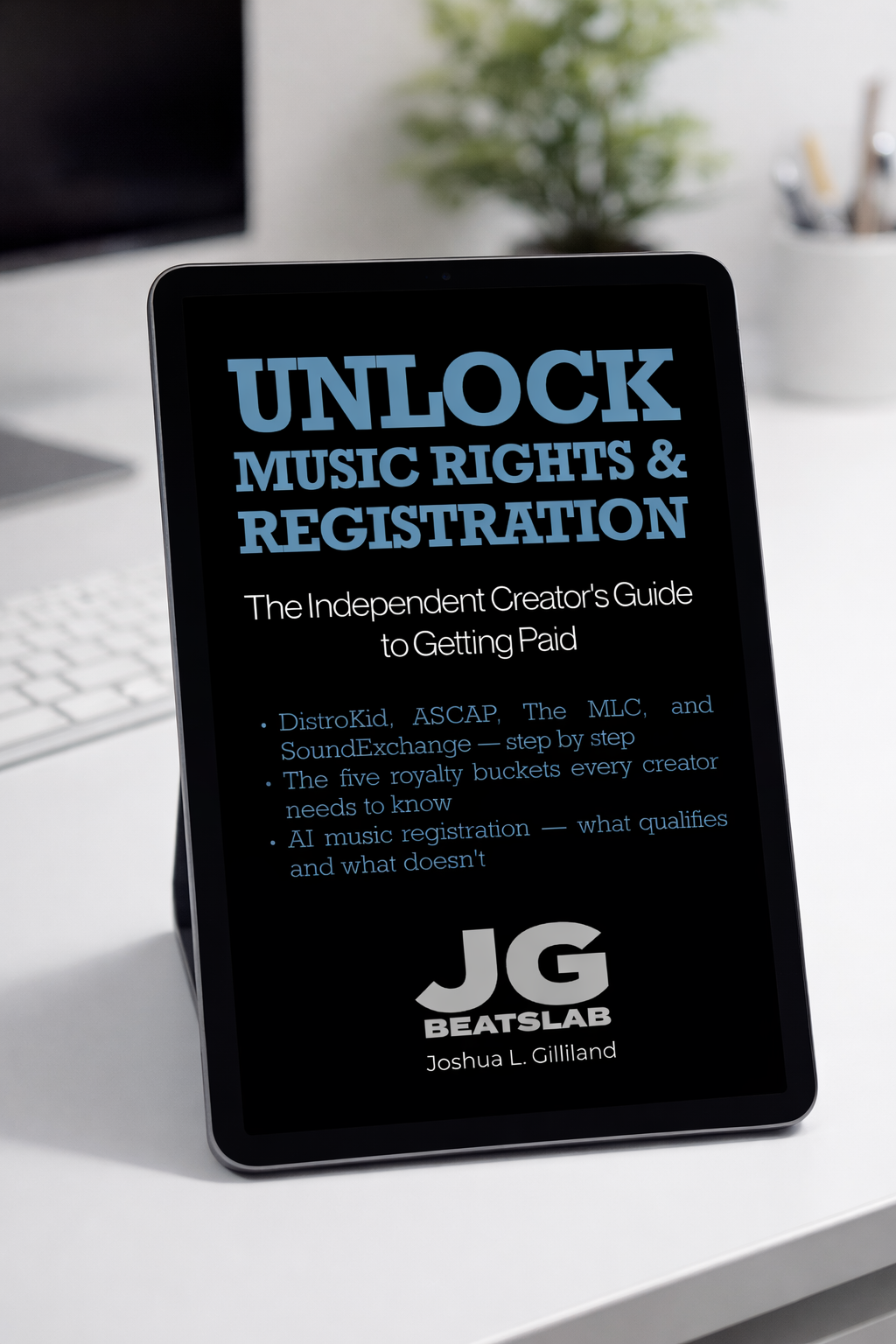
Unlock Music Rights & Registration is the "getting paid" phase of the Red Lab Path. You can make incredible music all day. If the registrations are wrong, the money never finds you.
This book teaches you how the four royalty systems actually work, how to register in each one, and how to avoid the fifteen most expensive mistakes independent creators make. Without this foundation, every stream, every playlist placement, and every download is sending royalties into the void.
The other books in the Red Lab Path teach you how to make the music. This one makes sure you get paid for it.
━━━━━
What You'll Master
Understand the five royalty buckets: Master-side streaming, songwriter performance, songwriter mechanical, sound recording digital performance, and neighboring rights. Plain language, no legal jargon.
Run the DistroKid upload flow correctly: Field by field walkthrough, including the Apple Music rejection traps that block half of first-time releases.
Register with a PRO (ASCAP, BMI, SESAC, or international equivalent): Full walkthrough for US creators plus guidance for PRS, SOCAN, GEMA, APRA, JASRAC, and the major global PROs.
Register with The MLC: The step most US creators skip entirely, and the one that collects your songwriter mechanicals from every streaming service.
Register with SoundExchange: The digital performance royalties on your sound recordings that nobody else is collecting for you.
Handle AI disclosure correctly: What the 2025 ASCAP / BMI / SOCAN joint policy actually requires, what the Thaler SCOTUS decision changed, what Apple Music Transparency Tags mean for your releases, and what the DDEX disclosure standard is doing across distributors.
Run the full release workflow: Phase 0 through Phase 7 across all four services, from mastered track to first payout.
Avoid fifteen expensive mistakes: Every one of them costs real money. Each one has a fix.
━━━━━
What's Inside
Ninety six pages. Twelve parts. Two workflow appendices.
Part 1: The Five Royalty Buckets
Part 2: Technical Prerequisites
Part 3: DistroKid (Distribution)
Part 4: Performing Rights Organizations
Part 5: The MLC
Part 6: SoundExchange
Part 7: International Notes
Part 8: The AI Factor
Part 9: The End-to-End Release Workflow
Part 10: Common (And Expensive) Mistakes
Part 11: Master Checklists
Part 12: Quick Reference (Registration Links)
Appendix A: Song Registration Worksheet
Appendix B: Metadata Master Sheet
━━━━━
Want the Full System: The Red Lab Library
Unlock Music Rights & Registration is one book. The Red Lab Library is the entire system, in one place, for one price.
✓ All seven books: Unlock AI Music, Unlock Suno: The Complete Guide, Unlock Music Rights and Registration, Unlock Music Promotion, Unlock Mureka, Unlock Reaper, and The AI Music Revolution
✓ Red Lab Protocol research reports: blind-tested platform comparisons
✓ Red Lab Case Studies: end-to-end production breakdowns of real tracks
✓ Genre Blueprints: tested prompt frameworks ready to use, the majority Red Lab Exclusive
✓ The Field Notes and the Quick Start Kit
✓ The 3-Song Sprint course
✓ Fader, your AI Studio Manager
Hundreds of creators across dozens of countries. $97, one time. No subscription.
jgbeatslab.com/store/p/red-lab-library
━━━━━
Format
Instant digital download. PDF + ePub. Readable on any device. Ninety pages, optimized for print and e-readers.
━━━━━
What This Is Not
This is not legal advice. This book is a registration workflow, not a legal guide. It does not cover US Copyright Office registration (a separate process and not required for most independent releases). It does not cover publishing deals, sync licensing contracts, or trademark questions. For legal questions specific to your situation, consult a music attorney.
This is also not a mastering guide. The workflow assumes you already have a finished, mastered, 24-bit WAV file ready to release. If you need help getting there, Unlock Reaper covers the mastering side.
━━━━━
After Purchase
You'll see a download button on screen immediately. A download link will also be emailed to you. Check your spam folder if you don't see it. Need help? Visit jgbeatslab.com/order-help.
The unifying principle across every registration system: claim only the human-authored portion of the work, and document the human creative contribution so the claim holds up under review.
The Four-Platform Policy Stack
DistroKid (the distribution layer) allows AI-generated music with conditions. The creator must own 100 percent of the rights, including the legal right to distribute music made with AI tools and any samples or lyrics involved, which means a paid commercial-tier AI subscription is non-negotiable. Free tiers of Suno, Udio, Boomy, and similar do not grant commercial rights. DDEX-aligned disclosure fields are supported. Spotify has stated that responsibly disclosed AI use will not be down-ranked. Undisclosed AI involvement that gets detected later carries significantly worse consequences than disclosed AI involvement flagged for review.
ASCAP, BMI, and SOCAN (the performance rights layer) jointly aligned their policies on October 28, 2025. Partially AI-generated works are eligible for registration, defined as works that combine AI-generated musical content with elements of human authorship. Fully AI-generated works are not eligible. There is no fixed percentage threshold. The standard is "human-led creative process with sufficient human authorship." AI tools cannot be listed as co-writers under any circumstance.
The MLC (the US digital mechanicals layer) grounds its posture in Copyright Office guidance. Works with sufficient human authorship are eligible for mechanical royalty collection. Works that lack sufficient human authorship are not eligible. The MLC has the authority to investigate registered works that appear to lack human authorship and to hold royalties in suspense pending the outcome.
SoundExchange (the sound recording digital performance layer) does not currently exclude AI-assisted sound recordings from collection. The Section 114 statutory license applies to the recording itself, not to the underlying composition's copyrightability. The open question for fully AI-generated recordings is who counts as the "featured performer" if no human performed. The safest approach is to ensure some identifiable human performance or direction is part of every release.
Apple Transparency Tags and the EU AI Act
Apple Music launched Transparency Tags on March 4, 2026. The system is a metadata disclosure mechanism with four flag categories: Artwork (AI-generated cover art), Track (AI-generated sound recording), Composition (AI-generated lyrics or musical composition), and Music Video (AI-generated video content). The tags are technically optional as of publication ("if omitted, none is assumed") and rely on labels and distributors choosing to apply them at delivery. The practical guidance is identical to Spotify's DDEX disclosure: when prompted, disclose truthfully. Disclosed compliance ages better than undisclosed avoidance, every time.
The EU AI Act Article 50 transparency obligations begin applying on August 2, 2026. Providers of AI systems will need to inform users and implement machine-readable marks for generative AI outputs in certain contexts. The exact platform-level implementation details are still being clarified by the European Commission, but the direction is set: transparency moves from optional to regulated for any music available in the EU.
The Best-Practice Workflow
Use a paid commercial-tier AI tool. Keep the receipt and the account confirmation as part of the project file. Free tiers do not grant commercial rights. This is non-negotiable across every platform in the stack.
Keep a creative log per release. A short project note file recording: which AI tools were used and at what subscription tier, what prompts or settings were used, what human lyrics or melodies or structural elements were contributed, what DAW work and edits were performed, what mixing and mastering decisions were made. The log takes about ninety seconds to write per song. Most creators will never need to produce it. The ones who do need it will be very glad they wrote it.
Credit humans, not AI tools, in every credit field on every platform. DistroKid Performer and Producer credits. ASCAP work registrations. MLC writer fields. SoundExchange performer claims. AI tools are not legal entities and cannot hold credits or copyrights.
Disclose truthfully when prompted, in the metadata field provided. The penalty for being caught with undisclosed AI is significantly worse than the friction of disclosing upfront, on every platform.
Never impersonate a real artist's voice or identity. Voice cloning of real people without explicit permission is the rule every platform enforces aggressively. There is no upside that justifies the downside.
Avoid spam upload patterns. Forty near-duplicates of the same track in a month. Tracks engineered to be exactly 31 seconds long to game royalty thresholds. Multiple artist profiles to evade upload limits. Streaming services hunt for these patterns specifically, and the penalties are severe.
Why This Matters in 2027 and Beyond
The direction of travel in AI music policy is toward more disclosure, more detection, and tighter enforcement, not less. A catalog built on documented human authorship and honest disclosure is in compliance with current policy and is very likely to remain in compliance as policy tightens, because the standard the policy is built on (human authorship) is not changing. The thing that is tightening is enforcement against undisclosed and misrepresented uploads.
A disclosed, human-led creative process is robust. An undisclosed or misrepresented one is fragile. The habit of documentation and honest disclosure compounds over the life of the catalog.
The full 2026 AI policy landscape, including the platform-by-platform registration walkthroughs, the creative log template, the four-platform stack workflow, and the international PRO considerations for creators outside the US, lives in Part 8 of Unlock Music Rights and Registration. The book is $9.99 individually. The Minimum Starter Kit at $27 includes it alongside Unlock Suno and Unlock Music Promotion, which together cover the production, registration, and promotion side of a disclosed Lane 2 release.
