
Most independent AI music creators build a catalog the same way. They generate a few tracks, master one or two, upload them to streaming, watch the play counts for a week, lose momentum when the numbers stay small, and stop. Six months later the workflow has gone cold and the catalog is five tracks deep. The pattern repeats.
The diagnosis is rarely a tool problem or a talent problem. It is a structure problem. There is no plan. The work happens when motivation arrives and stops when motivation evaporates, which is exactly the wrong shape for catalog building. A catalog needs consistent volume across a long enough window to generate real market signal. Motivation does not produce volume. A plan does.
The 90-Day War Plan is the production schedule that converts everything else in the Unlock System into a functioning catalog business. Three phases, thirty days each, with weekly action targets achievable in two or three focused sessions per week of two to three hours each. The plan is not motivational content. It is a calendar with deliverables.
Phase 1: Foundation (Days 1 through 30)
The Foundation phase exits with a finished EP, live direct-to-fan storefronts, and a workflow that runs without friction. The first two weeks run the 3-Song Sprint: Session 1 documents the artist identity (three words describing the sound, the emotional territory, the listener), Session 2 runs three Director's Cuts back to back, Session 3 takes the three tracks through Assembly, Human Touch, and Polish into finished masters.
Weeks 3 and 4 build the direct-to-fan infrastructure. For AI-assisted catalog work, Bandcamp is closed (the platform banned wholly or substantially AI-generated music in January 2026). The Lane 2 substitutes are Gumroad for asset packs and one-off downloads, Patreon or Substack Paid for subscription patronage, Ko-fi for tips and small direct purchases, or a Shopify storefront for full e-commerce control. Gumroad goes live in Week 3 with the first five mastered tracks bundled as a copyright-cleared production pack. A Patreon or Ko-fi page goes live alongside it for ongoing subscriber relationships. The generation and mastering rhythm settles: two generation sessions per week, one mastering session, two new masters per week as the steady target.
The Desert arrives in Week 4. Nothing is on streaming yet. The direct-to-fan platforms have almost no traffic. This is the phase where most creators abandon the plan. The interpretation of silence as failure is the single most expensive misread in the entire 90 days, because the silence is structural. The streaming algorithm cannot reward catalog it has not seen yet. The licensing marketplace cannot surface work it does not have yet. The store is being built before it opens.
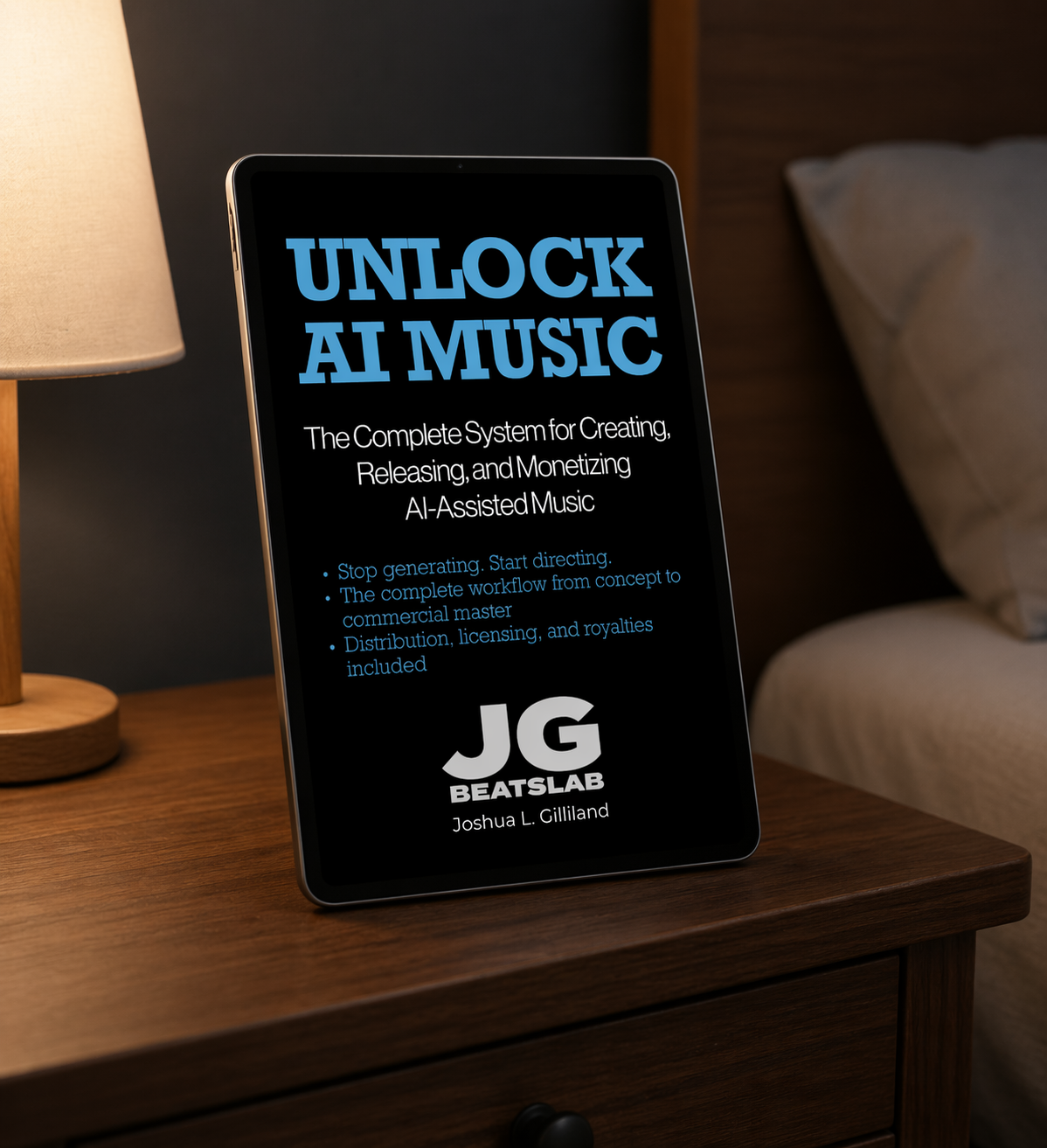
Start here. The complete foundation for a serious AI music catalog.
Most AI music education stops at "generate." Some goes as far as "mix and master." Almost none of it walks you through the complete system — from building your artistic identity through commercial release, royalty collection, catalog management, and long-term revenue strategy.
This is the book where you decide whether you are serious. Every other book in the Unlock series assumes you already know what you are doing. This is the one where you make that decision.
━━━━━
Where This Book Fits
Unlock AI Music is the entry point to the entire JG BeatsLab system. It is where you build the foundation — the mindset, the workflow, the business framework — before you go deep on any specific platform or tool.
Once you have the foundation, the rest of the Unlock series builds on it. Unlock Suno for platform mastery. Unlock Mureka for a second generation engine. Unlock Reaper for professional mastering inside a DAW. Unlock Music Rights & Registration for getting paid correctly on every release.
Or skip the individual books entirely and get everything at once inside Red Lab Library.
But it starts here.
━━━━━
What's Inside
205 pages. 12 chapters. 6 appendices. The complete end-to-end workflow for serious AI music creators.
The Director's Mindset — how to think about AI music before you generate a single note
The Infinite Studio Setup — your complete tool stack, from AI platforms through DAW integration
The Human Moat — what makes your music defensible, distinctive, and yours
Language as Instrument — advanced prompting strategy built on how these models actually work
The Director's Cut Workflow — from Golden Seed through finished commercial master
Quality Control and Taste Development — the systems that make every track better than the last
The Revenue Map — four royalty tiers, multiple income streams, all mapped
Platform Mastery — distribution, licensing, and Content ID across all major platforms
The 90-Day War Plan — a concrete catalog-building roadmap
Catalog Management at Scale — how to manage a growing body of work
Automation and Batch Production — how to scale output without sacrificing standards
Advanced Strategies — the long game for building a mature Lane 2 music business
Six appendices include a complete prompt library, platform setup checklists, a copyright registration guide, a revenue tracking template, an entrepreneur's toolkit, and a full troubleshooting handbook.
━━━━━
Want the Full System: The Red Lab Library
Unlock AI Music is one book. The Red Lab Library is the entire system, in one place, for one price.
✓ All seven books: Unlock AI Music, Unlock Suno: The Complete Guide, Unlock Music Rights and Registration, Unlock Music Promotion, Unlock Mureka, Unlock Reaper, and The AI Music Revolution
✓ Red Lab Protocol research reports: blind-tested platform comparisons
✓ Red Lab Case Studies: end-to-end production breakdowns of real tracks
✓ Genre Blueprints: tested prompt frameworks ready to use, the majority Red Lab Exclusive
✓ The Field Notes and the Quick Start Kit
✓ The 3-Song Sprint course
Hundreds of creators across dozens of countries. $97, one time. No subscription.
jgbeatslab.com/store/p/red-lab-library
━━━━━
Format
Instant digital download — PDF + ePub. Compatible with all major e-readers and PDF viewers. No blurry screenshots. 100% actionable operational data.
━━━━━
After Purchase
You'll see a download button on screen immediately. A download link will also be emailed to you — check your spam folder if you don't see it. Need help? Visit jgbeatslab.com/order-help
Phase 2: Distribution (Days 31 through 60)
The Distribution phase puts the catalog in front of the world. Week 5 schedules the first DistroKid release two weeks out, which gives Spotify's algorithm time to scan the tracks for Release Radar inclusion. AI disclosure fields get filled out honestly. YouTube Content ID gets enabled on every track (a passive income infrastructure that runs without ongoing effort).
Week 6 is the first streaming release. The discipline this week is not checking stats. The numbers will be small because the algorithm is testing the tracks with small listener pools before deciding how widely to serve them. The work in Week 6 is generating, mastering, and scheduling the next release, not refreshing the Spotify for Artists dashboard.
Week 7 adds active outreach. Five to ten YouTube creators in the 10,000 to 100,000 subscriber range whose content style matches the catalog. The pitch is short: a 30-second clip from a matching track, a one-paragraph note that says "I make [genre] music for [content type], free for your next video, no strings." No bio, no resume, no website. The track speaks first.
Week 8 initiates the Artlist (or alternative sync library) submission with five strongest masters. The review takes weeks. The seed is planted, then the work continues.
The feedback loop turns on in Phase 2. Which genres are accumulating streams organically? Which tracks on direct-to-fan platforms get downloads without paid traffic? Which YouTube outreach turned into a placement? The signal in the noise is what shapes Phase 3.
Phase 3: Optimization (Days 61 through 90)
The Optimization phase is where a business emerges from a catalog. Phase 2 generated real data. Phase 3 reads it and responds.
The Doubling Down Principle: take the strongest signal from Phase 2 and make one decision. What is the primary genre or style where the catalog is showing the most traction? Not the genre the creator hoped would work. The genre the data says is working. Double the output in that genre for Phase 3. Every Director's Cut Brief starts from the identity and style parameters of the strongest performing work. This is not abandoning the other catalog. It is adding more of what is already earning.
The cadence target shifts from two new masters per week to three. The workflow is now automatic. The cognitive load of learning is behind you. The output cost of each additional track is lower than it was in Phase 1.
Day 90 is a system review, not a celebration. Pull the data from every platform. Streaming numbers. Direct-to-fan downloads. Content ID revenue. Outreach placements. Then answer four questions with the data in front of you. What genre drove the most organic activity? Which tracks consistently outperformed the catalog average? What did not work at all? Where is the most friction in the workflow?
Those four answers become the Brief for the next 90 days.
The Realistic Day 90 Outcome
By Day 90 you are unlikely to be earning a full-time income. The realistic range is $50 to $300 per month, depending on execution quality, catalog size, and genre. That number is not the destination. It is the proof of concept. What Day 90 actually gives you is the catalog, the workflow, the data, the distribution infrastructure, and the lived experience of running the full methodology dozens of times.
The plan does not end on Day 90. It resets. The data from the first 90 days becomes the Brief for the second 90. The workflow built in Phase 1 runs faster in Phase 4. The distribution infrastructure built in Phase 2 generates compounding returns as the catalog grows.
The full 90-Day War Plan, including the weekly checklists, the Readiness Checkpoint, the Waterfall Strategy for staying two releases ahead, the Direct Pitch outreach script for YouTube creators, and the Phase 3 system review template, lives in Chapter 9 of Unlock AI Music. The book is $9.99 individually. It's also part of the Red Lab Library: every Unlock book, the research, and the Blueprints, for $97.
