
The Spotify Paid Stack and Why Most Artists Spend on the Wrong One
A friend texts you a screenshot at 11 PM. They just dropped a single, they have $200 to spend on promotion, and they are scrolling through three Spotify paid options trying to figure out which one to pick. Marquee, Showcase, Discovery Mode. Same dashboard. Same minimum spend in two cases. Same vague promise of "amplification." They ask which one they should use.
The honest answer is that two of the three are wrong for what they are trying to do, and most artists default to the wrong tool because Spotify presents them side by side as if they are interchangeable. They are not.
The three tools serve three different jobs, and matching the job to the tool is the entire decision.
What Each Tool Actually Does
Marquee is a full-screen takeover. A targeted listener opens Spotify, and your track appears as a full-screen promotion before they reach any other feature. It is the most intrusive format Spotify offers, which is also why it has the highest intent rate. Brian Hazard's published campaign data shows 29.6 percent intent rate for Marquee compared to 9.6 percent for Showcase in equivalent contexts. Minimum spend is $100. Cost per click runs $0.30 to $0.70 with most campaigns averaging around $0.50. Eligibility window is 18 days after release. Spotify requires the track to be live for at least 3 days before campaign launch, which means scheduling matters.
Showcase is a Home feed banner. A targeted listener opens Spotify, and your track appears in their Home feed alongside the personalized playlists and recommended artists they normally see. Minimum spend is $100. Cost per click is lower than Marquee at $0.30 to $0.40. Duration is fixed at 14 days. The eligibility window is open to any track at any age, which is the one thing Showcase has that Marquee does not. The intent rate is roughly a third of Marquee's, because a listener distractedly swiping a Home feed banner is committing far less attention than a listener tapping through a full-screen takeover.
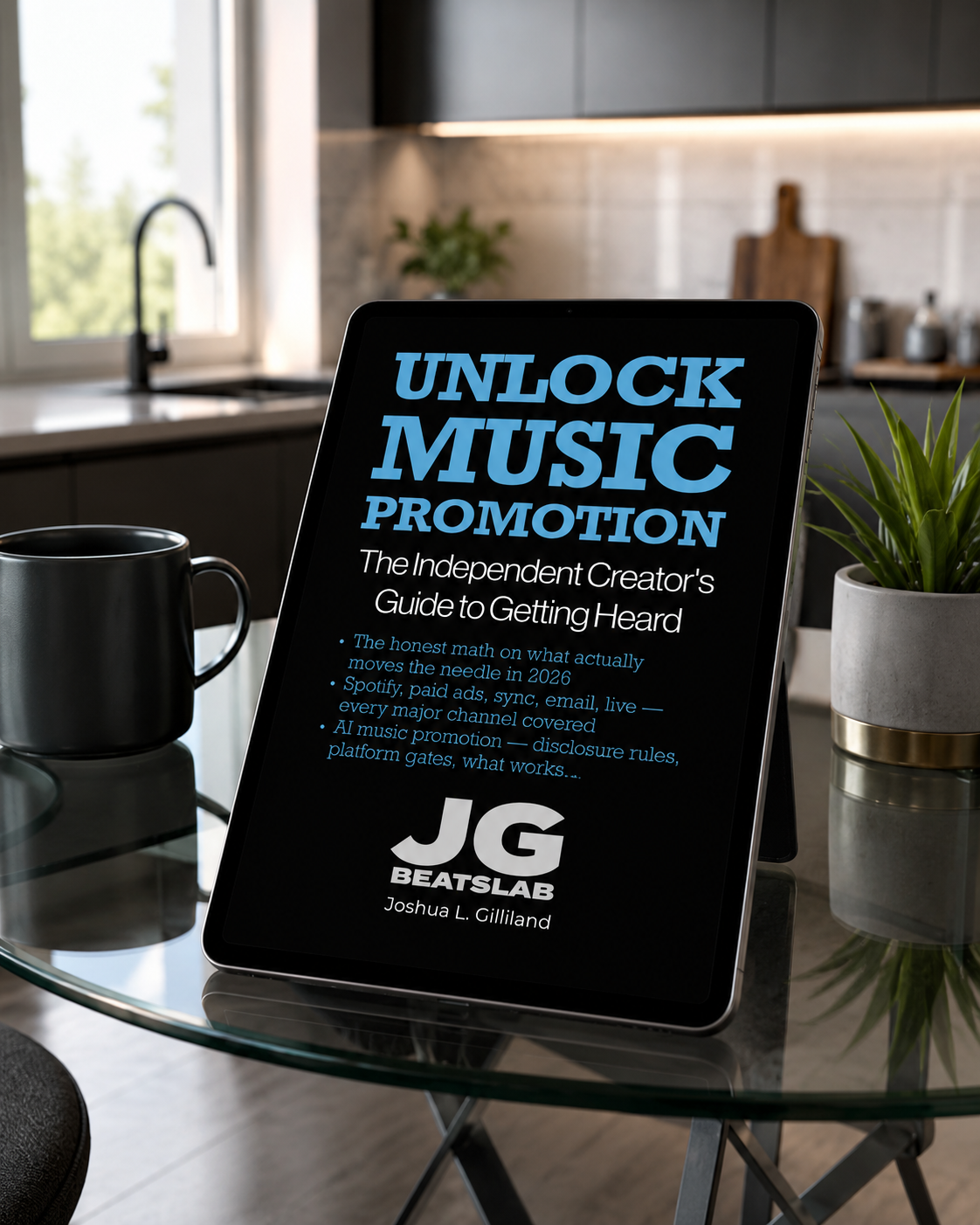
You made the track. Here's how to get it heard.
Most independent creators are great at making music and terrible at getting it heard. Not because they're not trying. Because the music promotion industry runs on advice that's structurally designed to keep you spending without working.
A promotion service that makes money selling playlist placements has no incentive to tell you that playlist placements alone rarely work. A podcast sponsored by an ad network has no incentive to tell you that Meta Ads cost-per-acquisition is often worse than the math suggests. A YouTuber with SubmitHub affiliate links has no incentive to tell you that 60% of SubmitHub submissions get declined.
The independent music promotion industry has become an echo chamber of hope dressed as strategy.
This book is not that.
━━━━━
What's Inside
58,000+ words. 22 chapters across 6 parts. 4 appendices. The complete music promotion landscape for independent creators in 2026, with every claim sourced and every recommendation grounded in actual platform mechanics.
Part I: Foundation. The math of 2026, the AI dimension, and the four diagnostic questions you ask before every campaign.
Part II: Streaming Platforms. Spotify discovery architecture, Spotify's paid stack (Marquee, Showcase, Discovery Mode), Apple Music, YouTube, Amazon, Tidal, Pandora, SoundCloud, and the release cadence mechanics that determine whether the algorithm picks you up.
Part III: Playlists, Paid Promotion, and Fraud. Legitimate playlist services, the playlist scam industry, paid ads across Meta, TikTok, YouTube, and Google.
Part IV: Social and Discovery. TikTok after the USDS deal, Reels and Shorts for the 45–65+ demographic, narrow-purpose platforms (LinkedIn, Threads, Bluesky, X).
Part V: Owned Channels. Email and newsletters — the most undervalued asset. Subscription, patronage, community. Bandcamp, the AI ban, and the direct-to-fan gap.
Part VI: Beyond Streams. Sync licensing. Press, podcasts, and the death of the music blog. Brand partnerships and cross-promotion. Live performance. Distribution and the AI music dimension. The long game.
Plus four appendices: Service Comparison Reference, Glossary, Promotion Math Quick Reference, and Resource Directory.
━━━━━
What You'll Master
How Spotify's algorithmic discovery actually works and what signals drive Discover Weekly and Release Radar placement. The Spotify Paid Stack — Marquee, Showcase, Discovery Mode — and when each is worth the spend. Release cadence mechanics: pre-save windows, day-one signals, and the 14-day algorithmic window. Legitimate playlist services versus the scam industry, and how to tell which is which. Paid ad math across Meta, TikTok, YouTube, and Google — what works, what doesn't, what the real CPA looks like in 2026. TikTok and Reels strategy for the 45-65+ creator specifically. The owned-channel layer: email, newsletter, subscription, community. Sync licensing — the highest-margin channel an independent can access. Distribution and AI disclosure mechanics in 2026.
━━━━━
⭐⭐⭐⭐⭐ "Makes me feel more like a producer rather than a helpless user. I now have a workflow and a methodology for maximizing what I get out of Suno." — Verified Purchase
━━━━━
Want the Full System: The Red Lab Library
Unlock Music Promotion is one book. The Red Lab Library is the entire system, in one place, for one price.
✓ All seven books: Unlock AI Music, Unlock Suno: The Complete Guide, Unlock Music Rights and Registration, Unlock Music Promotion, Unlock Mureka, Unlock Reaper, and The AI Music Revolution
✓ Red Lab Protocol research reports: blind-tested platform comparisons
✓ Red Lab Case Studies: end-to-end production breakdowns of real tracks
✓ Genre Blueprints: tested prompt frameworks ready to use, the majority Red Lab Exclusive
✓ The Field Notes and the Quick Start Kit
✓ The 3-Song Sprint course
✓ Fader, your AI Studio Manager
Hundreds of creators across dozens of countries. $97, one time. No subscription.
jgbeatslab.com/store/p/red-lab-library
━━━━━
Format
Instant digital download — PDF and ePub. Compatible with all major e-readers and PDF viewers.
━━━━━
After Purchase
You'll see a download button on screen immediately. A download link will also be emailed to you — check your spam folder if you don't see it. Need help? Visit jgbeatslab.com/order-help
Discovery Mode is not an ad at all. It is a royalty trade. You opt a track in, and Spotify increases its algorithmic distribution in Radio, Autoplay, and mix playlist contexts, in exchange for a 30 percent reduction in royalty rate on the streams that come from that amplification. If a stream would normally pay $0.004, it pays $0.0028 instead. The math only works if the volume uplift exceeds 30 percent. Practitioner data suggests genuine uplift falls between 15 and 40 percent depending on track, genre, and baseline engagement. If your uplift is 15 percent, you lose money. If it is 40 percent, you gain.
What Spotify Actually Requires Before You Can Run These
Eligibility is more specific than most artists realize. Spotify's display campaigns (which include Marquee and Showcase) require at least 1,000 streams in at least one target market over the last 28 days. Marquee adds a second requirement: at least 5,000 monthly active listeners in the selected target market. If the catalog does not clear those thresholds in any market, Marquee is not available regardless of how good the track is.
This is the gating reality. The paid Spotify tools are designed to amplify catalogs that already have measurable listener activity in a specific geography. They are not designed to launch a catalog from zero. Artists who try to use Marquee as a launch tool, before they have meaningful streams or listeners in any market, are not using the tool for its actual purpose.
Matching the Tool to the Job
Marquee is the right tool when the track is brand new, the baseline save rate is already at least 4 percent, the catalog clears Spotify's monthly active listener threshold in at least one target market, and the goal is to seed algorithmic signals during the post-release window. Hazard's data shows that a $100 to $150 Marquee campaign in week one produces measurably better algorithmic outcomes in weeks 3 through 5 than the same dollars split across four smaller campaigns over a month. Concentrate the spend. Run it once. Front-load it into days 1 through 7.
The mechanism is not the impression itself. It is the save and completion rate signals the impression generates. When 200 listeners click your Marquee and 20 of them save the track, Spotify's algorithm logs that 10 percent save rate and escalates your visibility through Release Radar, Radio, and Discover Weekly. 60 percent of Marquee campaigns see measurable algorithmic uplift in the 2 to 4 weeks following the campaign. The campaign is a catalyst. The algorithm does the actual work.
Showcase is the right tool when the track is older than 18 months (Marquee will not accept it), or when the goal is conversion to owned channels rather than streams. The lower cost per click and lower intent rate combine to produce a higher cost per stream, but a workable cost per acquisition for email signups or fan club traffic if the landing page is built right. Use Showcase as a secondary lever, not a primary one. Never use it for a new release when Marquee is eligible.
Discovery Mode is the right tool when the track is past release week, the save rate is already above 6 percent, and the goal is to extend the lifecycle of an existing winner. Discovery Mode does not save weak tracks. It amplifies tracks that already have algorithmic momentum, and it costs royalty share to do it. Pick one or two tracks per year that are genuinely working and give them the boost. Do not enable it across the catalog.
The Pre-Spend Diagnostic
Before any Spotify paid spend, run four questions. Does the track have a baseline save rate above 4 percent? If not, no campaign will fix it. Does the catalog clear Spotify's eligibility thresholds (1,000 streams in target market in last 28 days, plus 5,000 monthly active listeners in target market for Marquee specifically)? If not, the tool is not available regardless of budget. Is there a 3-day buffer before launch? Marquee needs the track live for at least 3 days. Is the budget at least $100? If less, paid Spotify tools are not eligible.
The dashboard makes the three tools look equivalent. The math says they are not. Match the tool to the job, run it in the right window, measure the algorithmic payoff, and the spend works. Default to the wrong tool and the $100 minimum becomes $100 spent on signal that the algorithm never amplifies.
The full Spotify Paid Stack breakdown, including the campaign math, the third-party playlist comparison, and the Plan, Run, Review framework for measuring algorithmic uplift, lives in Chapter 5 of Unlock Music Promotion. The book is $9.99 individually. The Minimum Starter Kit at $27 includes it alongside Unlock Suno and Unlock Music Rights and Registration.
