
I wanted to know what mastering actually does to AI-generated songs, in numbers instead of adjectives. So I measured every master I've delivered and a big pile of unmastered mixes. Before mastering, a third of the songs landed inside a common streaming loudness range. After mastering, 99% did.
Here's what I measured, what moved, and what I'm careful not to claim.
What I measured
78 masters I delivered.
69 unmastered files (68 WAVs and one MP3).
These are two groups of songs, not before and after pairs of the same song. Some albums have more masters than mixes in the folder, so the counts don't match. Read this as "what unmastered AI songs usually look like" next to "what my masters look like."
Standard measurements: BS.1770-4 integrated loudness, EBU loudness range, and 4x oversampled true peak. I checked my script against ffmpeg, and they agree within 0.1.
No song titles or customer names appear anywhere in this data.
The target zones below are common streaming norms that I checked against where my masters land. They aren't industry rules, and nobody hands out a certificate for hitting them.
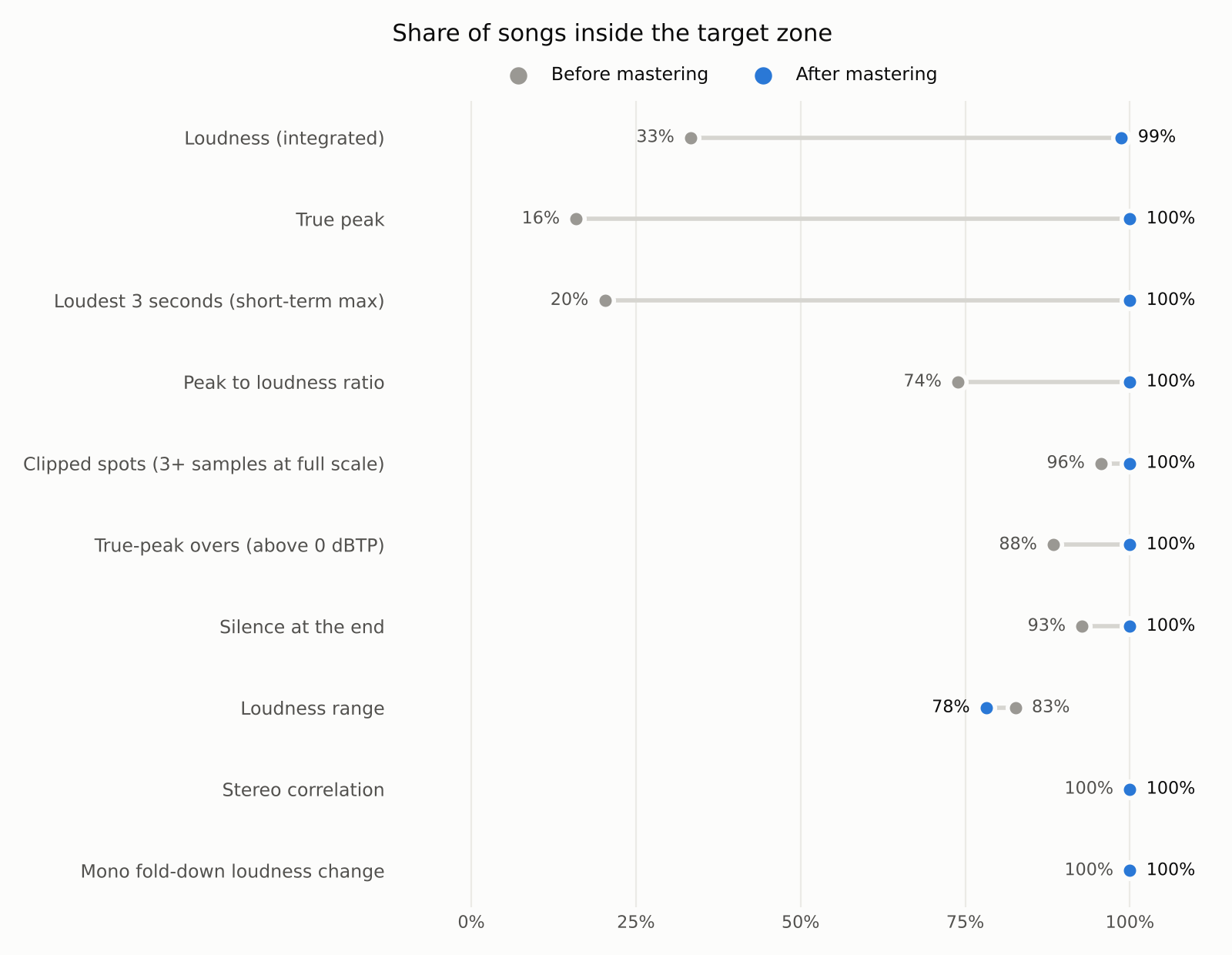
Share of songs inside each target zone. Gray is before mastering (69 files), blue is after (78 masters).
Loudness: from all over the place to one band
The middle 80% of unmastered files sat between -16.0 and -13.2 LUFS, with a median of -14.8. The full spread ran from -19.7 to -10.9. That's almost 9 dB between the quietest and loudest song.
After mastering, the middle 80% sits between -12.5 and -9.9 LUFS, with a median of -11.9. Inside the target zone of -14 to -9 LUFS: 33% before, 99% after. The one master outside it sits at -14.1, a dynamic song I chose to leave dynamic.
The loudest master is -9.6 LUFS. Nothing is anywhere near -7. Consistent is the goal here, not crushed.
Why consistency matters even with loudness normalization: normalization doesn't run everywhere. Spotify's own documentation says its web player and some third-party devices don't normalize. And an EP where track 3 is 5 dB quieter than track 2 sounds like a mistake on any player.
True peak: every master on the same ceiling
True peak is the highest point the waveform actually reaches once it's turned back into sound, including the peaks between samples. Unmastered files were all over the map: the middle 80% ran from -5.0 to 0.0 dBTP, and the full range from -10.6 to +0.7.
26% of unmastered files peaked above -1.0 dBTP.
12% went above 0 dBTP. Those are true-peak overs.
Inside the target zone of -3 to -1.0 dBTP: 16% before, 100% after.
Every master reads between -1.4 and -1.2 dBTP, and 97% read between -1.25 and -1.15. That's my house ceiling of -1.2 doing its job. Spotify asks for masters that peak below -1 dB true peak, because peaks above that can distort when the file is encoded for streaming.
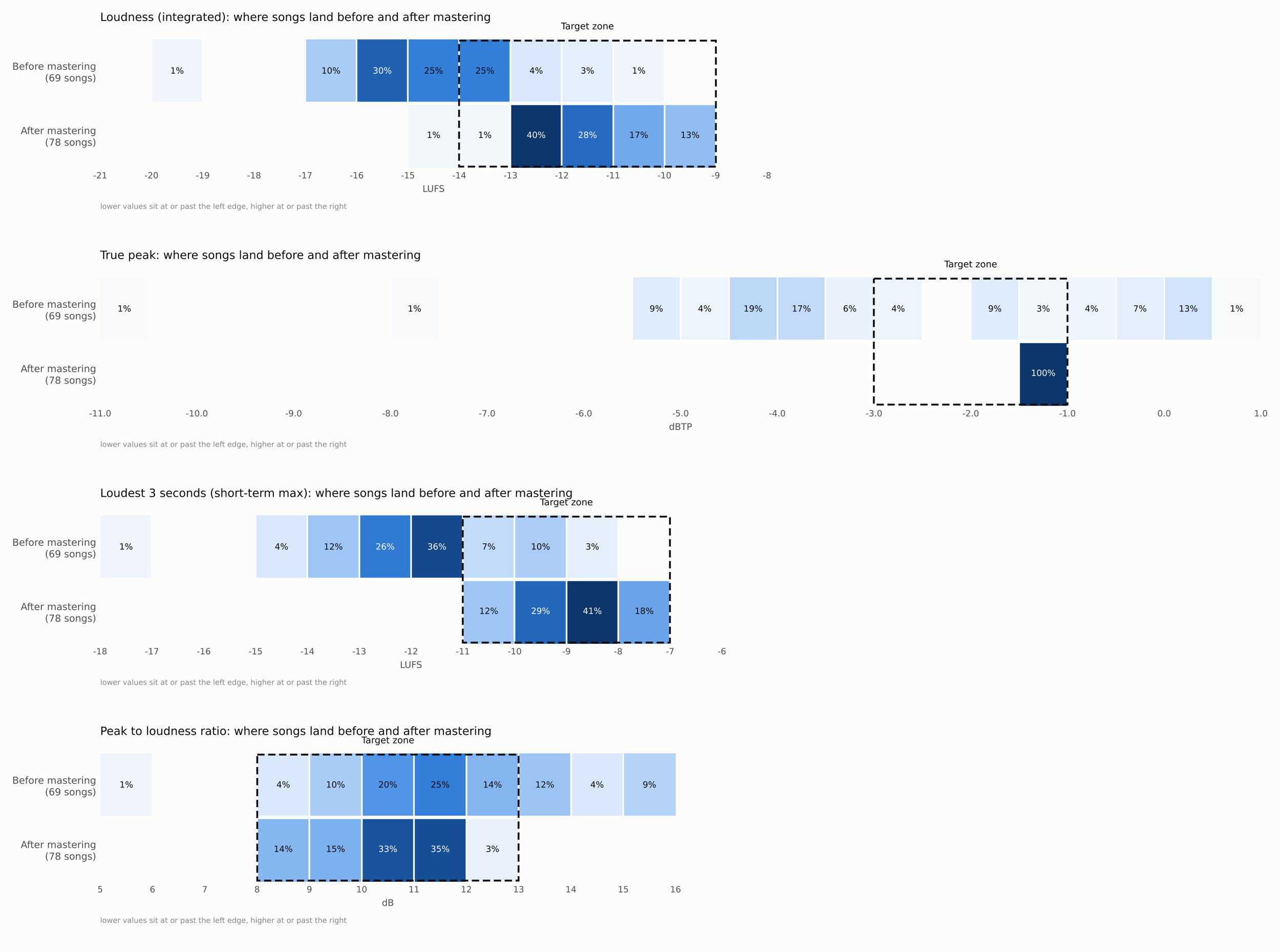
Where songs land on the four measures mastering controls. Each cell is the share of that group in that range. The dashed box is the target zone.
The cleanup nobody sees
Clipped spots: 4% of unmastered files had them. 0% of masters do.
True-peak overs: 12% before, 0% after.
More than 2 seconds of silence at the end: 7% before, 0% after.
Format: 81% of unmastered files arrived as 16-bit. Every master is 48 kHz, 24-bit.
None of these are dramatic on their own. Together they're the difference between a file that's done and a file that's almost done.
What this data doesn't say
Louder isn't better, and hitting a number doesn't make a song good. These numbers tell you a file is consistent and streaming-ready. They don't tell you it sounds right. That part still takes ears.
The two groups are different songs, so this shows typical before and after, not a controlled test on one track. On Thursday I'll cover the other half of the data: what mastering left alone. Short version: your mix stays your mix.
Check your own file
If you want to see where your song lands, I built a free checker called Track Lab. Drop in a file and it measures loudness, true peak, clipping and more. It's measurement only. It can tell you a number is off, but you still need ears to decide what to do about it.
If you'd rather hand it off, I master AI-generated music myself, start to finish.
